Every revenue organization inherits the same drawing. Leads pour in the wide end, friction removes the wrong ones, and money drips out the bottom. The funnel has explained sales since 1898, when advertising theorist E. St. Elmo Lewis first sketched it as AIDA, and it has never really been updated since.
It is also the wrong model, and using it is why companies with full pipelines still miss quota, why sales hires who worked everywhere else fail on schedule, and why boards keep mistaking a founder’s charisma for a repeatable machine.
A pipeline is not a chute governed by gravity. It is a feedback system, and the people standing around it are not looking at the same thing. Donella Meadows, the systems scientist whose 2008 book Thinking in Systems remains the clearest public account of how complex systems actually behave, made the point that applies here directly: when a system’s behavior looks irrational from outside, it is almost always because each actor is responding sensibly to the information and incentives visible from their own position in the system. Nobody in a broken pipeline is being stupid. They are each optimizing a different variable, and calling it by the same name.
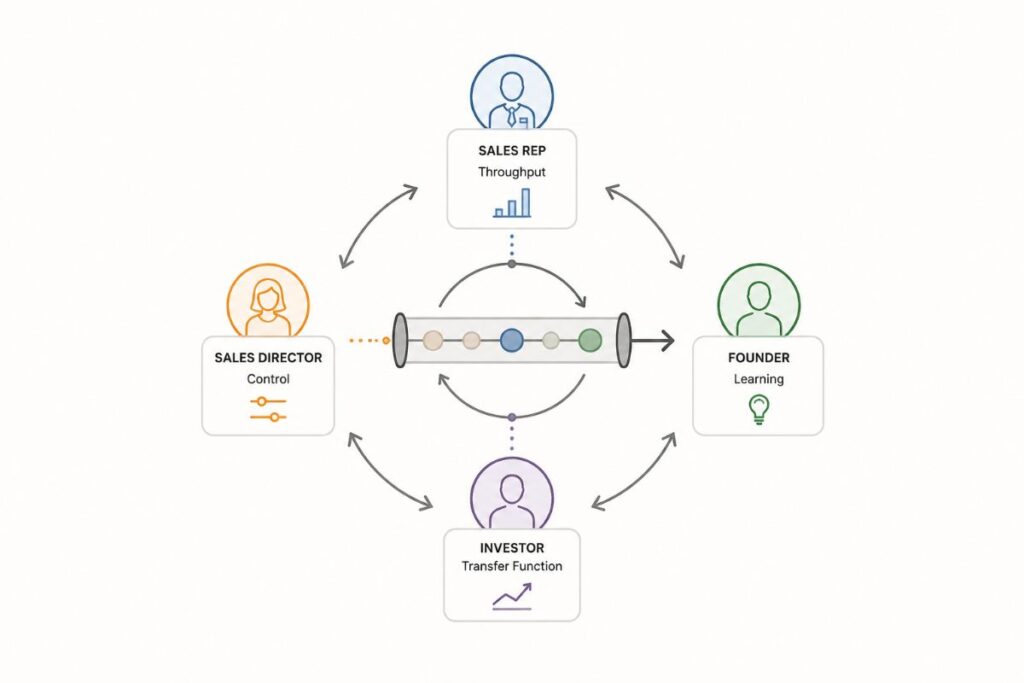
Four observers, one flow
The sales rep sees a local throughput engine. Leads go in, a closed deal comes out, and the only feedback that matters arrives fast: commission, hit or miss this quarter. This is an open loop. The rep acts on the input in front of them and gets almost no signal about what happens to the account eighteen months later, so their behavior optimizes for what is visible: speed to close, not fit.
The sales director sees something closer to a thermostat. Their job is to dampen the rep’s tendency to say yes to anyone, using stage gates, forecast discounting, and forced disqualification. In control theory this is a negative feedback loop, and it works exactly as intended when the criteria it is trained on are correct. It fails quietly when it prunes anything that does not match the standard pattern, which means it can strangle the exact anomalous, high-value deal that does not fit the template yet.
The founder, especially pre product-market fit, is running something else entirely: a sensing organ. Every conversation, especially every lost deal, is data about whether the core premise of the business is right. This is what organizational theorist Chris Argyris, working with Donald Schön, called double-loop learning: not just “how do I close this deal faster” but “does this deal’s failure mean my assumption about the product is wrong.” The problem is that founder-led sales carries variables nobody else can see: personal credibility, equity, informal promises. The deal gets marked “won,” but the signal underneath it cannot be reproduced by anyone else in the building.
The investor, finally, does not care about any individual deal. They are pricing the transfer function of the whole machine: how much capital and effort goes in, how much predictable revenue comes out, and critically, whether that ratio holds if the founder is removed from the equation. That last question is the one that actually determines valuation at scale, and it is the one most founders answer honestly only after the fact.
Four different instruments, reading the same pipeline, producing four different numbers that everyone insists is “the truth.”
What happens when one observer’s fix breaks another observer’s system
Eliyahu Goldratt’s The Goal, still the clearest single explanation of constraint theory in business writing, makes a point that generalizes past manufacturing: optimizing a subsystem in isolation does not remove the bottleneck, it just moves it somewhere less visible. HubSpot’s early sales history is a textbook case of exactly this, and it is worth walking through in detail because the company later fixed it in public.
Mark Roberge, HubSpot’s early head of sales and later author of The Sales Acceleration Formula, describes the company’s first commission plan: two dollars of commission for every dollar of monthly recurring revenue an account executive closed, with a short clawback window if the customer canceled fast. The plan was locally rational and locally successful. Reps chased volume, and HubSpot’s customer count went from roughly 100 to 1,000 in six months.
It also broke the system downstream. Reps were optimizing the one variable they could see, deal size and speed, and had no incentive to check whether a customer was actually a fit. Churn climbed, and the damage landed on customer success and product, nowhere near the rep’s own metrics. Roberge’s fix was to change what the rep’s local loop could see: he split commission by customer retention quartile, paying top-quartile reps four dollars per dollar of MRR and bottom-quartile reps one dollar. Within six months, churn attributable to sales dropped by roughly seventy percent. Nothing about the product changed. What changed was which feedback loop the rep was actually inside.
Zenefits shows what the same dynamic looks like without the correction. The company, an HR software platform that let small businesses also buy health insurance through it, hit a 4.5 billion dollar valuation in 2015 on the strength of aggressive quota-driven growth under founder Parker Conrad. But quota was the only number leadership was actually watching, and it was blind to what the number was being built on: BuzzFeed’s reporting later found that more than eighty percent of the company’s Washington state insurance deals had been sold by employees without the legally required broker license, a shortcut reps took to keep hitting activity targets. The scandal cost Conrad his job and cut the company’s valuation by roughly half within months. This was not primarily a forecasting failure. It was what happens when the only observer in the room is the one running the fastest, most locally rational loop, and nobody is checking what that loop is quietly externalizing.
The founder’s loop looks nothing like the other three
Christian Owens founded Paddle, now a billing and payments infrastructure company used by thousands of software businesses, as a consumer software marketplace in 2013. It generated about 800 dollars in its first two months. Almost nobody would call that a signal worth acting on inside a rep’s open loop or a director’s forecast model. But Owens was running the founder’s loop, not the rep’s, and he noticed something the aggregate revenue number hid entirely: customers were hacking around the marketplace to reach the checkout page directly, ignoring the product he had actually built. He read that as evidence that the premise was wrong, not that execution needed to improve, and scrapped ninety percent of the product to focus purely on checkout and billing infrastructure. That reframe, not a bigger sales team, is what turned Paddle into a business.
This is the distinction Brian Balfour, founder of the operator education platform Reforge and formerly VP of Growth at HubSpot, has argued for with colleagues in their critique of the funnel as a mental model: a linear funnel treats every input the same way and measures success by conversion at the bottom, while a founder running a real feedback loop is asking whether the inputs themselves are telling him something the model cannot see. A funnel cannot detect that the product is wrong. Only a sensing loop can.
The failure that repeats: promoting a sensor to a machine too early
Here is where most companies actually break, and it is not the point most founders expect. Paddle’s own second act shows it clearly. Years after the pivot, with the company already running fifty million dollars a year through the platform, Owens hired a team of senior enterprise sales reps to push upmarket. Nearly all of them quit within nine months. The product was not the problem. The problem was that the new reps were equipped to sell the value proposition of a one-million-dollar company, because that was the only playbook that had ever existed at Paddle, and nobody had yet built the version suited to an enterprise buyer.
This is not a Paddle-specific accident. SaaStr founder Jason Lemkin, whose community tracks startup sales hiring at scale, puts it plainly: seventy percent of first-time VPs of Sales do not make it a year. The pattern behind that number is almost always the same one Paddle hit: a founder’s double-loop, high-noise, bespoke learning process gets handed to a hire whose entire training is negative-feedback discipline, stage gates, forecast hygiene, standardized process. That hire is good at exactly the thing the company does not yet have: a stable, repeatable, already-discovered motion. Insert a governor into a system that is still supposed to be learning, and the system does not get faster. It stalls, because the new machinery is optimized to reduce variance in a process nobody has actually stabilized yet.
Jay Forrester, who founded the field of system dynamics at MIT and first described the bullwhip effect in his 1961 book Industrial Dynamics, offers the underlying reason this keeps happening: small distortions close to the source of a system, amplified by delay, produce outsized and confusing effects further downstream. His successor at MIT Sloan, John Sterman, later demonstrated the same dynamic experimentally. A founder’s early revenue, built on personal credibility and one-off deals, is exactly this kind of distortion. It looks like a stable signal from the boardroom. By the time the distortion is visible in a stalled sales team nine months later, the capital and the hiring decision are already spent.
The actual question
None of this is an argument against hiring sales leadership. It is an argument that the transition from founder-as-sensor to organization-as-machine is a specific, manageable event, not something that happens automatically once revenue crosses an arbitrary line. HubSpot changed what its reps’ loop could see before scaling it. Paddle, the second time, had to learn the hard way that a repeatable enterprise motion did not yet exist to hand off.
The question worth asking before the next sales hire is not whether the pipeline is big enough. It is whether what is being handed over is actually a machine yet, or still a sensor wearing a machine’s job title.
Sources
Donella Meadows, Thinking in Systems: A Primer (Chelsea Green Publishing, 2008) — chelseagreen.com
Eliyahu Goldratt, The Goal (North River Press, 1984) — background via Wikipedia
Chris Argyris and Donald Schön on double-loop learning — overview via Wikipedia
Mark Roberge, The Sales Acceleration Formula (Wiley, 2015); HubSpot’s compensation-plan pivot and the 70 percent churn reduction as recounted by Roberge, corroborated via OpenView Partners and Tomasz Tunguz
Zenefits: Forbes and HR Dive on Parker Conrad’s resignation and valuation; BuzzFeed News on the unlicensed-broker reporting and quota culture
Christian Owens, Paddle founder story: Computerworld UK, FirstMRR, and the SaaStr Club podcast, both the original pivot episode and the later enterprise-sales episode
Brian Balfour and colleagues (Casey Winters, Kevin Kwok, Andrew Chen), Reforge, on growth loops versus linear funnels — reforge.com/blog/growth-loops
Jason Lemkin, SaaStr, on first-time VP of Sales failure rates — saastr.com
Jay Forrester, MIT, on system dynamics and the origin of the bullwhip effect (Industrial Dynamics, 1961) — background via SciHi Blog; John Sterman, MIT Sloan System Dynamics Group — faculty page
E. St. Elmo Lewis and the 1898 origin of the AIDA funnel model — background via Toolshero