
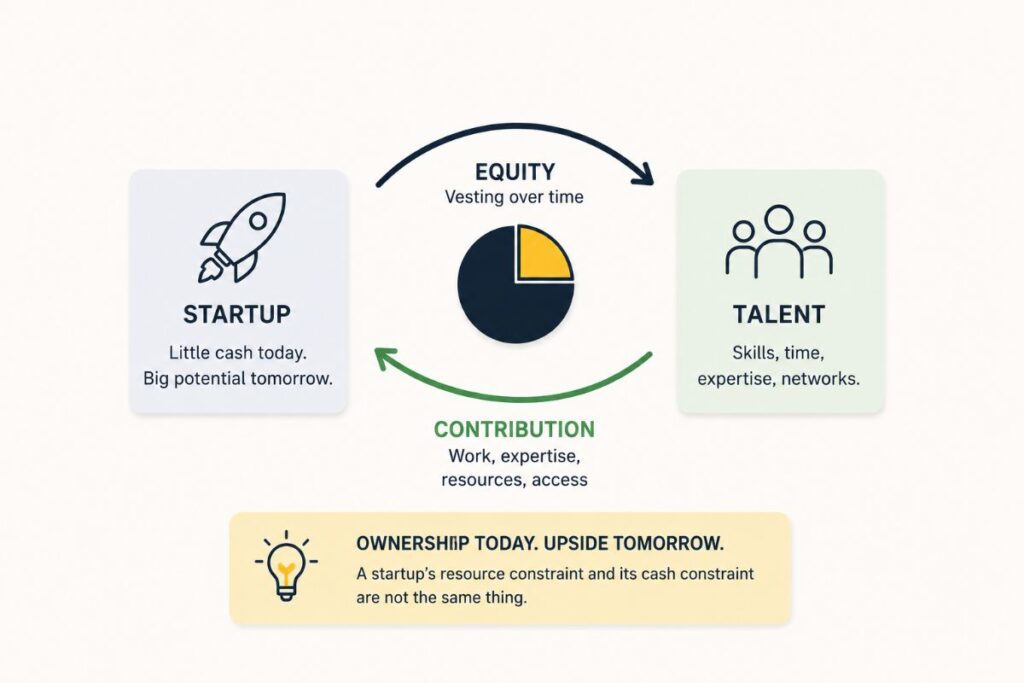
A startup with no cash still has something to spend. It has a claim on a future that does not exist yet. That claim can be exchanged for work, expertise, and access, the same way currency is exchanged for goods. It just settles later, and only if the company is worth something when it does.
This is not a new observation. Founders have traded ownership for contribution since before the term “startup” existed. But the mechanics of that trade are usually discussed piecemeal: a founder’s below-market salary here, an advisor’s option grant there, a vesting schedule buried in a term sheet. Treated separately, these look like a collection of compensation quirks. Looked at together, they describe something more specific: a resource-allocation mechanism that lets a company assemble capabilities before it can pay cash for them.
Three things that are not the same thing
Equity is ownership, a percentage of the company. Shares are the legal unit that equity comes in. Options are a right to buy shares later at a fixed price, not ownership itself, which is why an option grant and a stock grant behave differently under tax law and differently again when a company fails. Vesting is separate from all three. It is not compensation. It is the schedule by which promised ownership is actually earned, contribution by contribution, instead of handed over on day one.
Investor Brad Feld, who has written on vesting for two decades on his own blog at feld.com, frames the standard four-year schedule with a one-year cliff not as a concession to investors but as an alignment tool for founders themselves, protecting them from each other as much as from anyone else. The case that makes this concrete is Zipcar. Co-founder Robin Chase had a handshake 50/50 split with her co-founder, who left the company early. Without a vesting schedule attached to that stock, the departing co-founder kept half the company while contributing nothing further to building it, a story documented independently by Startup Grind and Capbase. Vesting exists specifically to prevent that outcome.
The distinction matters because “give them equity” gets used loosely to mean any of these four things, and each one carries a different risk profile for the person receiving it. It also matters because the people accepting these trades are not interchangeable. A founder sets the terms and has full information about the company’s condition. An early employee or advisor usually has neither, and as the research below shows, often can’t price what they’re being offered even when they try.
The exchange rate
Paul Graham, co-founder of Y Combinator, the startup accelerator that has funded companies including Airbnb and Stripe, wrote the clearest attempt to price this exchange in a 2007 essay called The Equity Equation. His formula is almost insultingly simple: giving up n% of the company is a good deal if what you get for it makes the remaining (100-n)% worth more than the whole company was before. Trade half the company for something that more than doubles its value, and the smaller slice you kept is worth more than the whole slice you started with.
Graham runs the formula in both directions. On the investor side, he points out that when Sequoia Capital, one of Silicon Valley’s oldest venture firms, takes 30% of a company, the deal only needs to improve that company’s odds by 43% to be worth it, a bar so low for a firm with Sequoia’s reputation that Graham calls it “a really good deal” for the founder. On the hiring side, he runs the same math to show that a new hire who is good enough to lift a two-founder company’s expected outcome by 20% is worth roughly 16.7% of the company at breakeven, though he is careful to note that breakeven isn’t the target. There has to be margin left over, and salary already paid comes out of that margin: Graham suggests treating a year of pay and overhead as worth about 1.5 years of stock, because a startup that grows will be paying next year’s salary out of a company worth roughly three times as much.
What Graham’s essay is really doing is putting a price on the currency startups use when they don’t have cash. Every one of these trades, whether it’s an investor, an early hire, or an advisor, is denominated in the same asset: a slice of a future that may or may not arrive. Jason Lemkin, founder of SaaStr and an active early-stage investor, applies the same logic in practice on his blog, suggesting a VP joining an early company should generally expect 1% or more, with the number rising if the company is unproven and falling if it’s already hot. He adds a detail that matters here specifically: at the earliest stage, that figure needs padding to absorb dilution from rounds that haven’t happened yet, because the equity someone accepts today is worth less by the time it’s actually earned unless that’s priced in upfront.
Ownership as leverage, not just compensation
Naval Ravikant, the founder of the startup funding platform AngelList and an early investor in Uber and Twitter, has argued for years that the fastest route to wealth is not renting out time for a salary but owning a piece of something that compounds without your continued input. Trading judgment and equity instead of hours, in his framing, is one of the ways people access what he calls leverage: work that pays off in proportion to the value created rather than the hours logged. It’s worth being precise about what this argument does and doesn’t establish. It’s an argument about incentives and upside, not a guarantee. It explains why a talented engineer might rationally choose a startup salary and a stock grant over a bigger paycheck at an established company. It does not, on its own, tell you whether that trade was priced fairly, which is where Graham’s math and the data below start to matter more than the philosophy.
The mechanism made explicit
If Graham’s essay prices the trade for a single transaction, Mike Moyer’s Slicing Pie model tries to price it continuously. Moyer, who teaches entrepreneurship at Northwestern, built the model after watching too many early teams split equity by guessing, at the exact moment they knew the least about how the company would actually unfold. His fix converts every unpaid contribution, hours worked below market rate, cash put in without a note, ideas, relationships, equipment, into a common unit he calls a slice, weighted by a risk multiplier because unpaid contribution is riskier than a cash salary. A person’s ownership share, at any given moment, equals their slices divided by all slices in the company. The pie itself is not static. It grows and reallocates as people contribute, and it freezes once the company can start paying market rates or raises outside capital.
Slicing Pie is the clearest illustration of the underlying claim in this piece: unpaid contribution is not a gift, it is a bet, and the fair way to price a bet is by what it would have cost in cash. Whether or not a company adopts Moyer’s specific formula, the framing underneath it, that a founder’s missing salary and an early employee’s below-market pay are both a form of at-risk investment that deserves to be tracked, is the more durable idea.
What the data says is actually happening
The theory holds up against what’s observable in the market. Carta, the platform that manages cap tables and equity for a large share of US venture-backed startups, tracks this exchange at scale. Its data shows the median founding team retains about 56% of the company by the time it raises a seed round and about 36% by Series A, the rest already traded away for capital, talent, and the option pool needed to hire, according to Carta’s own 2026 Founder Ownership Report. Pool sizing itself is stage- and region-dependent rather than a single fixed number, running from roughly 7% at pre-seed to the high teens by later rounds in Carta’s own reporting.
The clearest evidence that this is a live, adapting mechanism rather than a fixed custom is Carta’s H2 2025 compensation report: equity grant sizes for AI and ML engineers at the smallest companies have risen more than 60% over two years, even as median team sizes have been shrinking. Fewer people, larger stakes each, responding directly to a talent shortage.
Where the idea breaks
None of this makes equity a substitute for cash in any general sense, and treating it that way is where the mechanism turns dysfunctional.
The first problem is that equity cannot pay rent. A contributor accepting below-market pay for ownership is still, at some point, a person with real expenses, and a company that leans on equity to avoid ever addressing that reality is not allocating resources efficiently, it’s deferring a cash problem it hasn’t solved.
The second, more interesting problem is that people are bad at pricing the asset they’re being asked to accept. A 2023 Harvard Business Review study found that job candidates evaluating startup offers consistently treated a larger number of shares as automatically better compensation, independent of what those shares were actually worth. A separate legal and behavioral analysis by Yifat Aran and Raviv Murciano-Goroff, published as Equity Illusions, goes further: entry-level employees and women in particular are less likely to have the specific financial literacy needed to correctly value grant terms, and where employers aren’t required to disclose the details that would let them price it correctly, that misvaluation weakens their negotiating position, not just their understanding after the fact.
A separate, older line of research on public companies adds a useful warning, even though it doesn’t transfer directly. Nittai Bergman and Dirk Jenter’s study of stock option compensation at over 2,000 publicly traded firms found that companies grant more options to employees precisely when insiders believe their own stock is overvalued relative to its market price. Private startup equity has no observable market price to be overvalued against, so the finding doesn’t apply mechanically. But the underlying incentive it exposes does generalize: whoever controls the story about what the equity is worth has a structural reason to lean on that story when cash is short, which is exactly the condition under which a founder is most tempted to substitute equity for pay.
Put those together and the resource-allocation story gets a necessary complication. It only works as advertised, as a fair exchange rather than extraction, when the person taking the equity can actually price it, and when the founder offering it isn’t leaning on their own information advantage to make an unfavorable trade look better than it is. That’s a real constraint on the whole idea, not a footnote to it, and it’s also the clearest way this piece could be misread: nothing here is a case for using equity to avoid paying people what their work is worth in cash.
The third problem shows up on the cap table rather than in anyone’s paycheck. Graham himself flags what he calls “dead equity,” small stakes handed out to people no longer contributing anything, sitting on the cap table and doing nothing but diluting everyone still working. Professional investors are allergic to this for a specific reason: a messy cap table, full of small, disengaged holders, signals to a Series A or B investor that the company’s ownership doesn’t map cleanly onto who is actually building it, which is exactly why vesting cliffs exist and why serious equity plans get tracked with the same discipline as a cap table, not handed out on a handshake.
The studio version of the same bet
Venture studios push this same logic to the level of an entire portfolio. Independent industry surveys put typical studio ownership somewhere between 30 and 60% of each company built, a range confirmed both by industry reporting on the studio model and by an academic study of European studios published in ScienceDirect, which found actual stakes varying from 15% to 75% depending on how hands-on the studio is, with named studios like eFounders holding closer to 30% and more controlling studios like Blenheim Chalcot taking considerably more. The trade is for functions a normal founding team would otherwise have to buy separately or find in co-founders: technical build capacity, operational infrastructure, and initial capital, deployed across many ventures instead of one. Done well, this can leave an individual founder with more personal equity than they’d have ended up with after finding and splitting ownership with two or three traditional co-founders, because the studio is effectively standing in for those missing co-founders rather than sitting alongside them as a fourth claimant.
The failure mode is instructive, and it’s the same failure mode as the individual case scaled up: a studio that takes a large stake without functioning as a genuine co-founder risks having later-stage investors read the cap table and see a founder who doesn’t look sufficiently incentivized, regardless of the underlying reality. Fractal, a studio independently referenced in separate industry research as offering unusually large-stake terms, is cited by one industry newsletter, the Venture Studio Forum, an outlet whose stated mission is advancing the studio model as an asset class, as an example of portfolio companies losing follow-on investor interest over exactly this concern. That account is worth noting as a plausible mechanism rather than a verified outcome, since it comes from a single, interested source. The mechanism it describes doesn’t depend on that one case being airtight: a studio’s equity has to be legible to the next person evaluating the cap table, or the exchange collapses under its own appearance of dysfunction even when the underlying economics were sound.
What this actually is
Equity, options, shares, and vesting are not one thing, and none of them is simply a substitute for a paycheck. But taken together, structured with real vesting and priced with something like Graham’s discipline or Moyer’s tracking logic, they form a genuine allocation mechanism: a way for a company with no cash to still assemble the people it needs, by paying them in a claim on value they are being asked to help create. It’s also worth saying plainly what that claim usually turns out to be worth: most startup equity ends up worth nothing, because most startups don’t survive to a liquidity event. Nobody in this piece, from Graham to Moyer to Carta’s own data, is pricing equity as if it were cash with better upside. They’re pricing it as a bet, which is the whole reason a risk multiplier belongs in the math at all.
That reframes the actual constraint. A startup’s resource constraint and its cash constraint are not the same thing, because there is a second asset on the balance sheet, credible future upside, that can be spent even when the bank account can’t. It has real edges. It breaks when the person accepting it can’t price it, when a founder leans on that mispricing rather than correcting for it, or when the stake looks, from the outside, like it doesn’t match the contribution behind it. Those aren’t reasons to distrust the mechanism. They’re the maintenance it requires, and skipping that maintenance is how “paying in equity” turns into just not paying people.
Which raises the actual question for a founder staring at a hire, a contractor, or an advisor they can’t afford in cash: is “we can’t afford this” actually true, or is it just the answer you get when you’ve only priced one of the two currencies you have?
Sources
Paul Graham, “The Equity Equation”, July 2007
Brad Feld, “Term Sheet: Vesting”, Feld Thoughts
Startup Grind, “3 Reasons Why Founder and Employee Stock Should Vest Over Time” (Zipcar case)
Mike Moyer, Slicing Pie
Naval Ravikant, The Almanack of Naval Ravikant
Jason Lemkin / SaaStr, A Basic Structure for a VP Sales Comp Plan
Harvard Business Review, “When It Comes to Compensation, More Equity Isn’t Always Better”, September 2023
Yifat Aran and Raviv Murciano-Goroff, “Equity Illusions”, 2022
Nittai Bergman and Dirk Jenter, “Employee Sentiment and Stock Option Compensation”, NBER
Going VC, “The Rise of Venture Studios”
“Venture studios beyond the hype: Key challenges and a way forward”, ScienceDirect
Venture Studio Forum, “The Fatal Flaws in the Venture Studio Model”, May 2025 (single-source account, flagged as such in text)