What Happens When Understanding the Market Becomes Continuous
The market has always been speaking continuously. Buyers have always been comparing options out loud, complaining to each other, describing what they wish existed. What changed is not the market. It’s a founder’s ability to listen to it continuously, instead of in scheduled bursts.
For most of the last two decades, understanding the market was a phase you completed and then moved past. Vision and intuition gave way to formal market research, which gave way to Lean Startup interviews, which gave way to product analytics dashboards. Each step made the phase more rigorous. None of them questioned that it was a phase.
The first real crack in that model came from founders who started measuring fit as an ongoing score rather than a milestone. Rahul Vohra, founder and CEO of Superhuman, an email client built for speed, published a detailed account in 2018 of how he built what he called an engine for finding product-market fit. Instead of treating fit as something you either have or don’t, he surveyed users on a recurring basis, asking how disappointed they’d be if the product disappeared, then segmented and re-surveyed based on the answers, feeding the results directly back into what got built next. It wasn’t multi-channel and it wasn’t public; it ran on his own user base through his own surveys. But it broke the assumption that research was a phase, because the loop never actually closed. It just kept running, quarter after quarter, as the product changed.
A messier, more public version of the same instinct shows up in how Daryna Kulya, co-founder of the business phone company OpenPhone, has described using Reddit. Her own account is refreshingly specific about what Reddit has actually been for at each stage: primarily customer acquisition in the company’s early years, then community management as an unofficial support channel emerged around the company’s own subreddit, and only as a smaller third use, market research, illustrated by a single post asking customers directly what they wanted to see from the product in the coming year. The part worth noticing isn’t that research was the main use. It’s how she does the listening that is continuous: she runs an alert tool that flags any Reddit thread mentioning her brand or competitors, and checks it throughout the day, treating public conversation as a standing input rather than something to go looking for occasionally. It’s manual, it’s one channel, and it depends entirely on her own bandwidth to read and interpret what comes in. But it is genuinely continuous rather than scheduled.
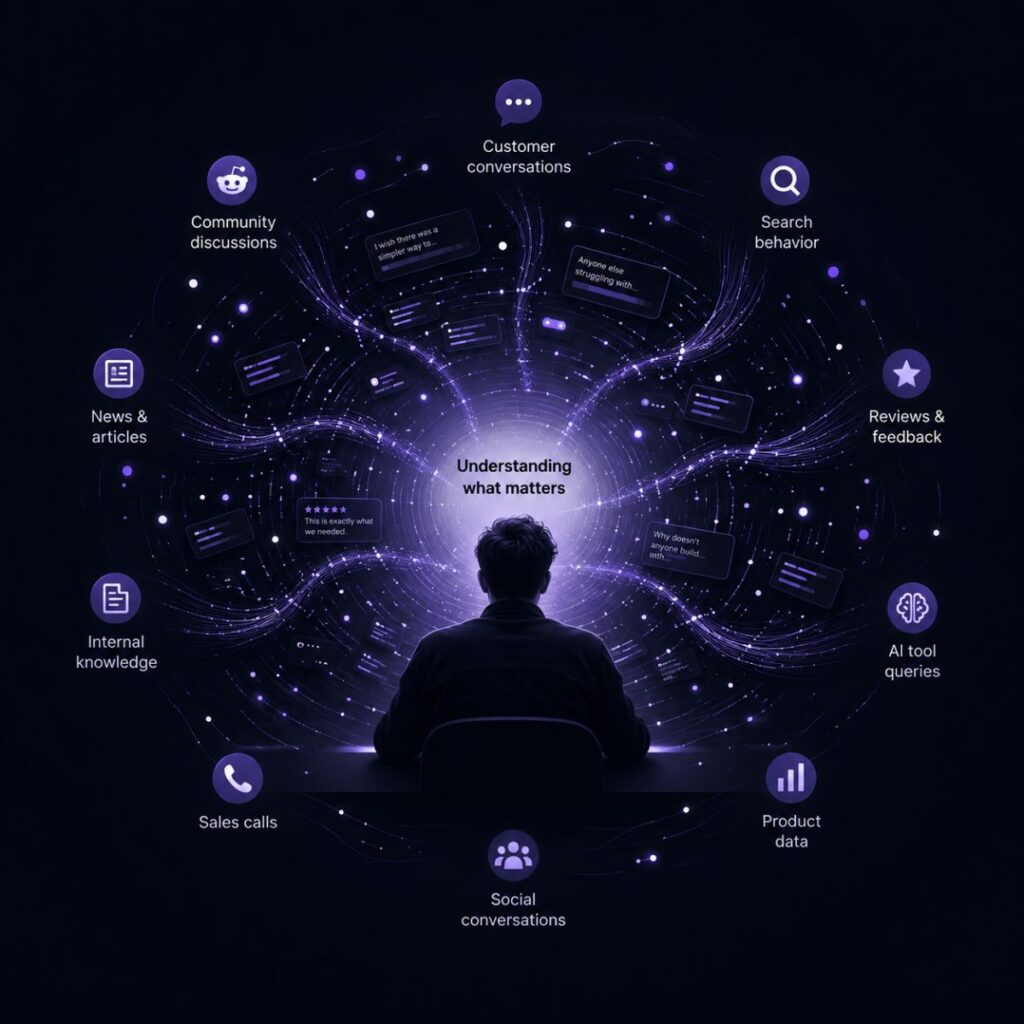
Line these up and the gap becomes obvious. Vohra’s engine runs continuously but only sees people who are already users, and only through the survey he designed. Kulya’s listening reaches people who aren’t yet customers, but it’s confined to one platform and one person’s attention. Between the two, most of where market signal actually lives goes uncovered: search behavior, product reviews, sales call transcripts, the specific language people use with AI tools when they’re trying to solve a problem your product might solve. Each of these has started attracting its own vendor category of monitoring tools in the last two years, which is itself a signal that founders are reaching for something none of the earlier tools were built to do: not more feedback, but one continuous view across all of it.
That’s the specific gap we’ve been trying to close with what we call relevance-based understanding at Relefy. The starting premise is that there’s no shortage of information anywhere in this picture; there’s a shortage of a way to connect fragments scattered across news, search, social conversation, reviews, sales calls, and internal data into an answer to a specific question a specific person is trying to decide something about. Traditional tools start from a source: pull everything from this dataset, this channel, this CRM. This approach starts from the question instead, something like what a target market is struggling with right now, and searches across every relevant environment for signals that answer it. Paired with what we call Precision Surround, the same understanding also shapes where and how that answer gets communicated once you have it, rather than treating distribution as a separate problem to solve with a bigger channel later. It’s one attempt at doing systematically what Vohra and Kulya were each doing manually within the limits of a single loop or a single platform. Whether it’s the right one is still being tested in practice, same as any other approach in this piece.
The founders still running on the older model aren’t wrong that research matters. They’re working with an outdated unit of time. Research used to mean a phase you finished before building. It’s becoming a layer that runs underneath every decision, continuously, whether or not any single founder is built to use it that way.
The open question is what happens to founder judgment once that layer is doing real work in the background. Intuition built the first generation of great companies precisely because there was no better source of signal available. It isn’t obvious yet whether founder instinct becomes less important once the market can, in effect, speak for itself continuously, or whether it becomes more important as the scarce skill shifts from gathering the signal to knowing which of it actually matters.
Sources
Vohra, R. (2018). How Superhuman built an engine to find product-market fit. First Round Review.
Kulya, D. (2025, February 13). How I used Reddit to get our first 1,000 customers. Founder to Founder.