In July, we asked who would decide which projects get access to Finland’s increasingly contested electricity capacity. In August, we found three mechanisms already answering that question at once: parliament trying to set an explicit rule, the grid deciding implicitly through connection queues, and municipalities approving projects with limited information about the wider consequences.
We missed a fourth answer. The biggest buyers may be starting to decide for themselves.
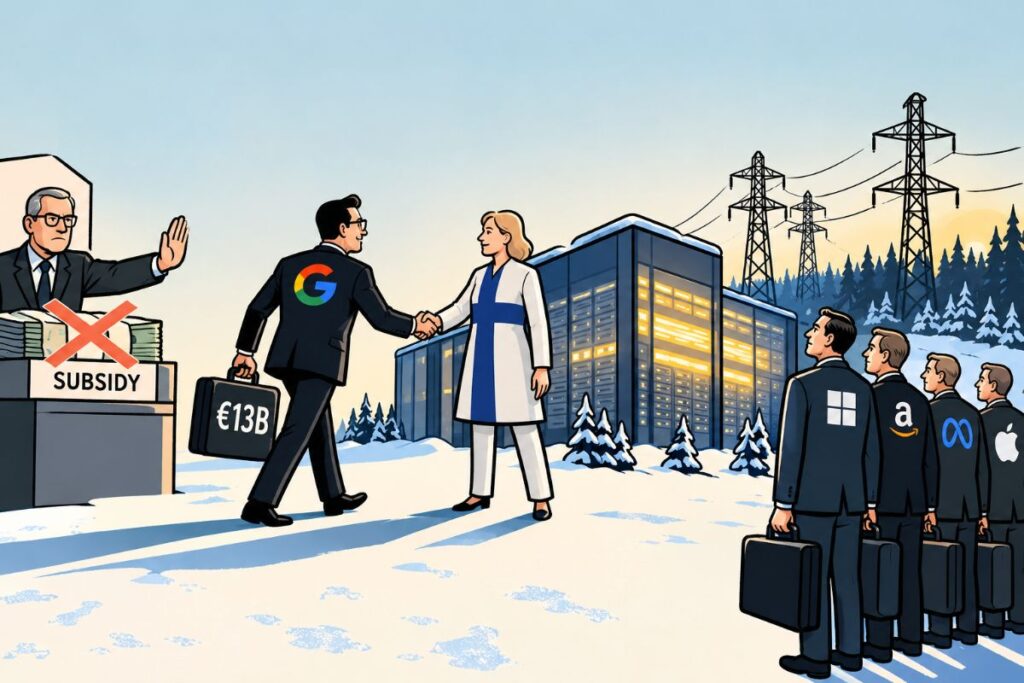
Google announced this week that it will invest at least 13 billion euros in Finland through 2027 and 2028, its largest single European commitment. The headline number is not the interesting part. What matters is the shape of the deal underneath it, because it looks less like a company renting space in Finland’s electricity system and more like a company building its own wing onto it.
What Google actually agreed to
Google signed a 22-year power purchase agreement with Fortum tied to the Loviisa nuclear plant, which currently supplies roughly 10 percent of Finland’s electricity. The agreement takes effect in 2028 at a smaller volume, then rises to cover 50 percent of Loviisa’s output for the period 2030 through 2049, a figure confirmed independently by DataCenterDynamics, World Nuclear News, and Fortum’s own statement, though it does not appear in Google’s press release. Fortum describes the deal as an offtake contract entered into its long-term hedge ratio, its own language for distinguishing it from a short-term market hedge, meaning it functions as a genuine multi-decade commercial claim on half the plant’s production, not a one-off transaction.
This is worth being precise about, because that claim is commercial, not physical. Google does not receive a dedicated transmission line from Loviisa, and Finnish electricity still flows through the same pooled Nordic market everyone else draws from for actual delivery. What the PPA does is give Fortum the revenue certainty to fund a roughly 1 billion euro life-extension and upgrade program, which both companies say would not otherwise have kept the plant running past 2030. Google and Fortum have also signed a memorandum of understanding to explore new generation and flexibility capacity at the site, including the commercial case for new reactors, which is an intention to keep talking, not a commitment to build anything.
Separately, Google added new onshore wind PPAs with Valorem and Suomen Hyötytuuli, bringing its total contracted new-to-the-grid wind capacity in Finland to 629 megawatts, and a 94 MW battery storage system near its Kajaani site, due online in late 2027. The company is also expanding its existing Hamina campus, a converted paper mill, and building new sites in Kajaani, Muhos, and Vaala, chosen partly for spare grid capacity near carbon-free generation in northern Finland. Fingrid’s own CEO, Asta Sihvonen-Punkka, welcomed the siting specifically because the north has “significant grid capacity… in the production dominated north,” which keeps network build-out costs down for the whole system, not just for Google.
Four projects, four different relationships to the constraint
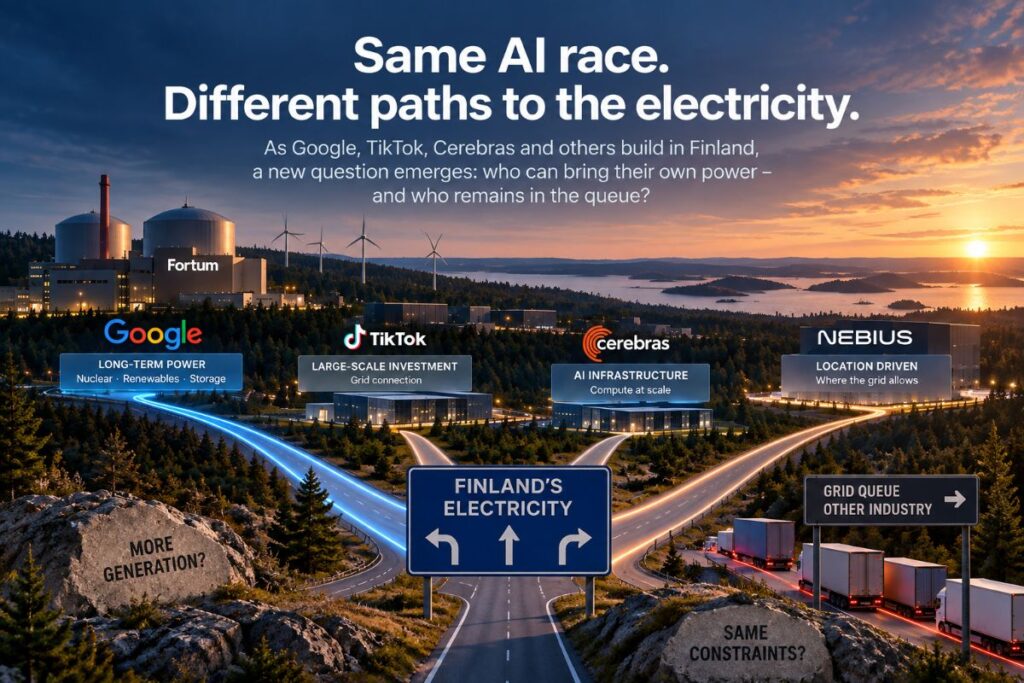
The question this raises is whether Google is representative of how Finland’s data center boom actually works, or an outlier. Comparing it against three other major projects announced or advanced since July suggests the latter, and the difference is instructive.
TikTok is building two Finnish sites, in Kouvola and Lahti, as part of its 12 billion euro Project Clover initiative, together worth roughly 2 billion euros and totaling up to 278 megawatts of capacity. Both are developed and owned by the Finnish company HyperCo Oy. TikTok’s own disclosures describe it as a tenant that becomes the operator once each facility is available for use. Nothing in the public record shows TikTok signing its own power purchase agreements, financing new generation, or adding storage. Its electricity relationship to the Finnish grid runs entirely through its landlord.
Cerebras Systems, the AI chip company, is doing something structurally identical in Mikkeli. Compute Nordic Finland is building and operating a 165 MW campus under seven-year capacity agreements, with Cerebras as the anchor customer. Compute Nordic’s own language is explicit about the division of labor: it leads project development, energy relationships, and operator responsibility, while Cerebras buys committed capacity. There is no indication Cerebras has any direct exposure to, or control over, how that capacity gets generated.
Nebius sits somewhere in between, and its own history is the clearest illustration of what article 2 called the grid deciding by default. Nebius wanted to expand its Mäntsälä campus, and Fingrid’s connection restrictions in Uusimaa sent the investment to Lappeenranta instead, 200 kilometers away. That is a company whose location was shaped by the constraint, not a company that engineered its way around it. Nebius has separately contracted for its own electrical substation infrastructure at Lappeenranta, a 15 million euro deal with Caverion, but nothing comparable to Google’s multi-decade generation and storage commitments has surfaced.
Set side by side, the pattern is not that hyperscalers as a category behave differently from other data center tenants. It is that one company, so far, has behaved differently from every other company in the pipeline, including some very large ones. TikTok and Cerebras represent close to 450 megawatts of combined Finnish capacity without either company touching the generation side of the equation at all. Google’s Loviisa, wind, and battery commitments span 629 MW of contracted wind alone, plus whatever share of Loviisa’s roughly 1,000 MW the life-extension deal actually represents, a figure Google has not disclosed.
Does this add more electricity, or just change who gets access to it?
The more important question is not whether Google can afford to do this. It obviously can. It is whether what Google is doing helps solve Finland’s electricity constraint or simply lets one company buy its way past it while everyone else queues.
There are two different things happening inside the same announcement, and they cut in opposite directions. The Loviisa life-extension is closer to additive: both companies say the plant’s operations beyond 2030 depended on this revenue certainty, meaning the generation capacity being secured would not otherwise exist on that timeline. The same logic applies to the 629 MW of wind PPAs, which Google describes as new-to-the-grid capacity, and the battery system, which adds flexibility the system did not have before. On this reading, Google’s money is expanding Finland’s total electricity supply, which is a real public benefit, not a private end-run around scarcity.
But a contracted claim on half of an existing nuclear plant’s output for twenty years is also, by its own structure, a reservation other long-term buyers cannot hold at the same time. Fortum’s own accounting treats it as a customer contract, not a market hedge, which means that half of Loviisa’s production is now committed to one buyer for two decades regardless of what any other company might have offered for the same capacity. Even generation that would not exist without Google’s money becomes, once contracted, a resource nobody else can bid for during that period. Both things are true at once: the deal plausibly grows the pie, funding upgrades and life extension that would not otherwise have happened, and it plausibly locks up a large share of it for one company before anyone else gets a chance to compete for it. Which effect dominates depends on how much of Finland’s coming supply growth ends up structured this way, which is not yet knowable from a single deal.
The employment numbers, checked
Google’s own release is specific enough to check cleanly against the pattern article 1 flagged in Ramboll’s industry-commissioned study, and it holds up. During the two-year construction phase, 2027 to 2028, Google says the investment will support more than 37,000 jobs nationwide, generating an average 3.6 billion euros a year in GDP contribution during that window. About 16,000 of those jobs are direct construction roles. The rest is the broader multiplier effect, suppliers, contractors, local spending, tied to the building phase itself.
Once the facilities are running, Google’s own projection drops to 7,000 jobs annually, a figure it says includes on-site technical and facility roles, upstream equipment and service suppliers, and the local businesses those workers support, the same kind of broad, multiplier-inclusive definition Ramboll used for its industry-commissioned study in article 1. Measured on that comparable basis, both figures blending direct, indirect, and induced employment, Google’s steady-state number runs at roughly 19 percent of its construction-phase number. That is close to the “roughly a quarter” ratio article 1 found in Ramboll’s data. The pattern holds: a large headline figure tied to the temporary building phase, and a much smaller number once the facility is actually operating, even from a company disclosing more detail than most.
Vestman’s bill, updated
Article 2 left one falsifiable question open: would the Economic Affairs Committee weaken or advance Heikki Vestman’s bill, which would bar large data centers from connecting to the grid until they cover their own consumption with new generation or flexible capacity. As of the most recent reporting, from September 3, the bill has not been resolved. It remains with the committee. What has changed is the temperature around it. Support has grown from just over 100 MPs in June to, according to Tekniikan Maailma, more than half of parliament by September. At the same time, opposition has hardened. Energiateollisuus’s markets director, Pekka Salomaa, now calls the bill “hätävarjelun liioittelua,” disproportionate self-defense in the legal sense, warning it would put an emergency brake on Finland’s electricity-driven growth. Finland’s renewable energy association counters that more than 7.2 gigawatts of permitted wind and solar projects are already sitting ready to build, several times data centers’ projected 2030 demand, which undercuts the scarcity premise the bill is built on. Worth noting without overreading it: this fight is also unfolding ahead of spring 2027 parliamentary elections, which gives the bill a political life independent of its technical merits.
Google’s deal complicates the bill in a specific way. Vestman’s proposal would require data centers to bring their own generation before connecting. Google has just demonstrated, voluntarily and ahead of any legal requirement, roughly the shape of arrangement the bill wants to mandate. That could be read as evidence the market is already solving the problem the bill exists to force, or as evidence that only the largest, best-capitalized operators can do voluntarily what the bill would require of everyone, which would leave smaller developers exactly as exposed to the connection queue as before. Both readings are consistent with the same set of facts, and only one bill outcome, or its absence, will tell us which one Finland is actually building toward.
The municipality question, briefly revisited
Article 2 found Salo approving land sales without knowing its tenant, and a Yle investigation since then found Forssa’s kaupunginjohtaja, Jari Kesäniemi, explicitly stating he does not believe Finland’s largest data center project will affect electricity prices, with Yle’s broader reporting suggesting municipal leadership generally does not treat price and grid impact as its responsibility. That is a sharper version of what article 2 called information asymmetry: not a gap in what municipalities know, but a gap in what they consider themselves accountable for, even though zoning and permitting sit entirely in their hands. Nothing in the material reviewed for this piece changes that picture. It remains the least resolved of the three original mechanisms.
A two-tier system, tested against the evidence
The hypothesis worth naming directly: Finland’s electricity allocation question may be splitting into two different problems for two different kinds of buyer. Tier one, so far occupied by exactly one company, can combine multi-decade PPAs, storage, wind financing, and a seat at the table with the grid operator and a nuclear utility, effectively building its way around the constraint. Tier two, which includes TikTok, Cerebras, and by extension every developer leasing capacity to them, remains dependent on ordinary grid connections, market electricity procurement, and whatever Fingrid’s queue allows.
The evidence for this is real but thin. One data point is not a tier, it is an outlier until a second and third company do something comparable. What would strengthen the hypothesis is a second hyperscaler signing its own multi-decade generation deal in Finland within the next year. What would weaken it is Google’s arrangement turning out to be a one-off shaped by its specific relationship with Fortum, or mid-sized developers gaining access to similar PPA structures through aggregation, a possibility Finland’s grid consultation process, open until early September, could plausibly enable if it lowers the transaction cost of smaller players bundling demand.
What would prove this wrong
A few developments would meaningfully undercut the thesis in this piece. If Fingrid’s grid buildout accelerates fast enough that connection scarcity stops being the binding constraint, the whole premise of a two-tier system collapses, since there would be nothing left to build around. If a wave of announced projects, including Google’s own later phases, get delayed, scaled down, or cancelled relative to their contracted capacity, that would suggest the pipeline has been overstated relative to what actually gets built, which is exactly the caveat Fingrid itself has attached to its 40 percent consumption growth estimate. If mid-sized industrial users start securing PPA and flexibility arrangements comparable to Google’s, the tier structure dissolves into a general market evolution rather than a hyperscaler-specific one. And if Vestman’s bill passes in a form that applies uniformly and smaller developers can meet its terms as easily as Google can, that would suggest policy, not capital size, ends up doing the allocating after all.
What to watch
The signals worth tracking over the next six to twenty-four months: whether any other hyperscaler in Finland signs a comparable multi-decade generation or storage deal, what the Economic Affairs Committee actually does with Vestman’s bill and how each side reacts to whatever it decides, whether Fingrid’s autumn grid connection consultation changes how smaller developers can access capacity, and whether Google’s later investment phases proceed on the announced scale or get quietly revised. Any one of these would tell us more about where this is heading than another announcement of gigawatts and billions ever could.
The next question
Finland’s first data center question was how much investment it could attract. The second was whether the grid could accommodate it. The one emerging now may matter more than either: whether the resources to build around Finland’s electricity constraint are available to everyone, or only to the handful of companies large enough to become, in effect, their own utility.
Sources
Google Cloud Press Corner, official announcement of the 13 billion euro Finland investment, Fortum PPA, wind PPAs, battery system, and full employment/GDP figures: https://www.googlecloudpresscorner.com/2026-09-09-Google-Deepens-Commitment-to-Finland-with-Two-Year-EUR13-Billion-investment-in-AI-Infrastructure
DataCenterDynamics, Google-Fortum nuclear PPA structure and 50 percent offtake confirmation: https://www.datacenterdynamics.com/en/news/google-signs-nuclear-ppa-with-fortum-in-loviisa-finland/
World Nuclear News, PPA terms and Loviisa life-extension program: https://www.world-nuclear-news.org/articles/google-signs-up-for-electricity-from-finnish-nuclear-power-plant
Eurasia Review (Fortum statement republished), PPA structured as long-term hedge-ratio customer contract, RONA impact: https://www.eurasiareview.com/09092026-fortum-and-google-partner-to-drive-sustainable-growth-for-finland-sign-nuclear-power-purchase-agreement/
EU Today, Google’s 13bn Finland investment and siting rationale: https://eutoday.net/google-13bn-finland-ai-infrastructure/
TikTok Newsroom, Project Clover Kouvola data center announcement: https://newsroom.tiktok.com/finlanddatacenter?lang=en-150
CNBC, TikTok’s 150 MW Kouvola capacity and tenant structure: https://www.cnbc.com/2026/09/08/tiktok-expand-data-center-capacity-finland.html
GlobeNewswire, Cerebras and Compute Nordic Finland 165 MW Mikkeli announcement: https://www.globenewswire.com/news-release/2026/09/01/3353779/0/en/cerebras-and-compute-nordic-finland-announce-new-165-mw-ai-data-centre-in-mikkeli-finland.html
Yle, Nebius Lappeenranta announcement and Mäntsälä/Fingrid grid-restriction backstory: https://yle.fi/a/74-20218223
Tekniikan Maailma, Vestman bill status, Energiateollisuus and renewable-energy association reactions, September 2026: https://tekniikanmaailma.fi/lehti/16b-2026/sahkon-hinta-kallistuu-ilman-datakeskuksiakin/
STT / Kokoomuksen eduskuntaryhmä, Vestman bill signatures and committee referral: https://www.sttinfo.fi/tiedote/72167903/kokoomuksen-vestmanin-lakialoitteelle-datakeskusten-tiukoista-ehdoista-yli-100-kansanedustajan-tuki?lang=fi
Fingrid / STT, nearly 40 percent consumption growth estimate if signed connection agreements are fully realized, August 2026: https://www.sttinfo.fi/tiedote/72239761/sahkonkulutus-on-kaantymassa-voimakkaaseen-kasvuun-rinnalle-tarvitaan-lisaa-saatovoimaa?publisherId=69819787&lang=fi
Yle, Forssa, Kesäniemi, and municipal accountability for electricity price impact: https://yle.fi/a/74-20242796
Relefy, “Finland’s Real Data Center Question Isn’t About Tax” (13 July 2026): https://relefy.io/article/finland-s-real-data-center-question-isn-t-about-tax-esvcLO
Relefy, “Finland Is Already Deciding Who Gets the Electricity. Just Not in One Place.” (19 August 2026)