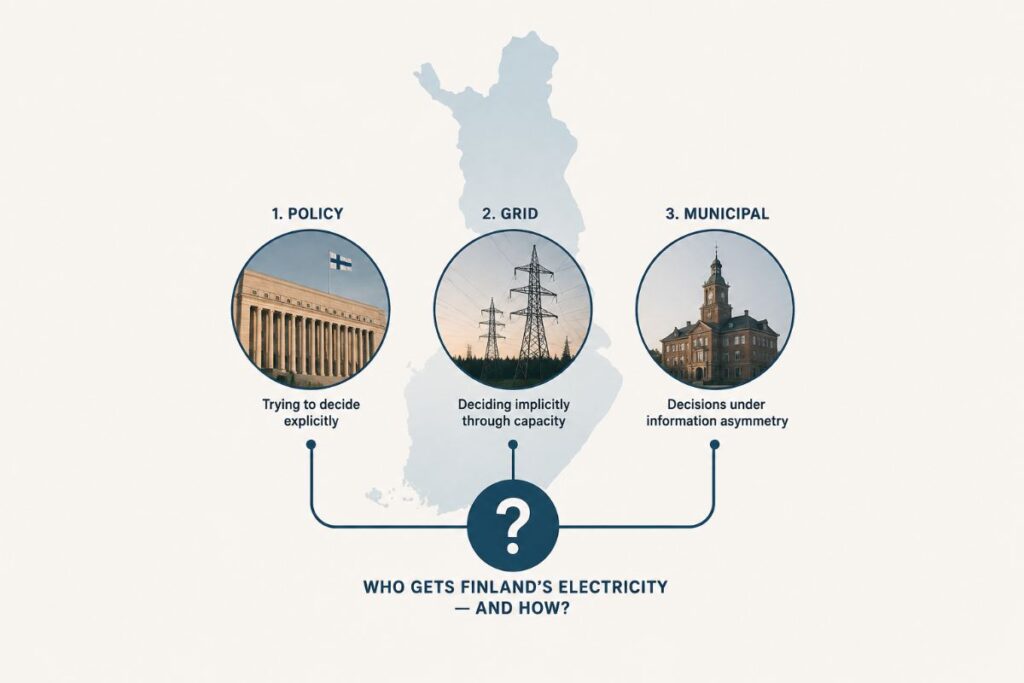
In July, the question sitting under Finland’s data center boom was whether the country would decide, deliberately and in public, which industries get priority access to its electricity, or let that decision get made by default, one grid connection at a time. Five weeks on, the tax fight that dominated headlines has faded. The underlying question has not. It has just split into three separate processes, each answering a piece of it differently: a parliamentary bill trying to set the rule in advance, a flagship project whose location was already settled by grid capacity before anyone voted on anything, and a city that sold land without the information to know what it was agreeing to.
None of the three has resolved anything on its own. Read together, they show how much of this decision is being made quietly, in places the tax debate never touched.
Parliament is trying to set the rule before the fact
Heikki Vestman, a National Coalition Party MP from Uusimaa and a member of parliament’s Economic Affairs Committee, filed a private member’s bill in May that would bar grid companies from connecting any large data center until it can cover its own consumption with new power generation or flexible capacity, wind, nuclear, or fast-start reserve. Smaller centers face a lighter version of the same rule. The model is Ireland’s additionality requirement, in force since the start of this year.
The bill drew signatures from more than 100 MPs across government and opposition, an unusual show of support for a single member’s initiative, and now sits with the Economic Affairs Committee. Vestman’s argument is that if data centers lock up existing power generation for years, Finnish households and businesses absorb the price increase while new supply is built, a process that takes years on its own.
Antti Poikola, executive director of Datakeskusteollisuus, the trade association for Finland’s data center industry, does not dispute that the underlying problem is real. He disputes the fix, and the comparison it rests on: Irish data centers consumed roughly 22 percent of the country’s electricity in 2024, against something closer to 2 percent in Finland, which he argues makes Ireland’s rule the wrong template here. Vestman’s counter is that waiting until Finland’s numbers resemble Ireland’s is the failure mode the bill exists to prevent.
Neither side has actually settled the argument. What matters more is that this is the first point in the whole debate where Finland is attempting the deliberate version of the decision, in a legislature, with named tradeoffs, rather than through a minister’s rally-stage comments or a quiet tax bracket change. Whether the committee waters the bill down or lets it stand will say more about how this gets decided than anything either side has argued so far.
The grid is already deciding, without anyone voting on it
While parliament debates that explicit rule, a more implicit one has already played out, on the same company the July piece used as its backdrop. Nebius, the Amsterdam-based AI infrastructure company that emerged from Yandex’s international assets after the Russian business was sold off in 2024, operates Finland’s largest existing data center in Mäntsälä and is building a second, far larger one in Lappeenranta: 310 megawatts, valued above 8 billion euros.
Mäntsälä was supposed to keep that expansion. Hannu Laurila, the town’s kunnanjohtaja, wanted Nebius to grow where it already operated. The grid said otherwise. Fingrid, Finland’s transmission operator, had restricted new large connections in Uusimaa over capacity constraints on the southern network, and Nebius’s second campus went to Lappeenranta, 200 kilometers away, not by ministerial decision or parliamentary vote, but because a connection queue pointed the money elsewhere.
That is the default mechanism the July piece warned about, deciding where a multibillion-euro project lands before policy gets a say. Lappeenranta’s version of it looks better than most: the local grid operator expanded capacity in advance, from roughly 180 megawatts toward more than 500, specifically to accommodate large industrial users before they arrived. Solar Foods, a Finnish company developing protein production from air-based technology, is now lining up for a share of that same expanded capacity. Both projects fit for now. Whether they still fit once Nebius’s later phases come online is the open question, the Finnish version of what already happened in Sweden, where a data center’s grid claim forced a bakery, Pågen, to relocate a planned expansion.
A city that sold the land before it had the information
The smallest version of the same question is playing out in Salo, a city of roughly 50,000 best known as Nokia’s former manufacturing base. The city council approved selling nearly seven hectares to Regant DC1 Oy, a project company owned by the developer Regant, for a data center on the site of the former sugar factory, at a price fixed the previous year: 50 euros per square meter, just under 3.5 million euros total.
Matti-Juho Ervasti, Regant’s chief executive, has not disclosed which company will operate the facility. He estimates at least a hundred permanent jobs once it is running. Salon Seudun Sanomat, the local paper, ran an editorial asking whether the agreed price reflects the land’s real value, noting that Finland’s data centers increasingly end up serving companies whose profits dwarf the state’s entire annual budget. That is the editorial board’s judgment, not a settled fact, and the city has not disclosed enough for an outside reader to check it.
What is verifiable is narrower and still worth noting: Salo agreed to a price before knowing who the tenant would be. That is not the same conflict of interest a Helsingin Sanomat investigation found in Helsinki, where board members with undisclosed lobbying ties to Google and TikTok sat on the committee deciding data center siting. Salo’s version has no one abusing an information advantage. It has a city that made a real estate decision without the information that would normally shape one.
Three processes, no coordination between them
Finland is not failing to decide who gets priority access to its electricity. It is deciding three times, in three places, with no mechanism connecting them. A bill in committee is trying to set the rule in advance. A queue at a substation already moved a multibillion-euro project two hundred kilometers without anyone framing it as a policy choice. A city signed a contract with less information than the company on the other side of the table. None of the three will settle the question by itself, and nothing currently forces them to agree.
The July piece asked whether Finland would make this decision deliberately or by default. The honest answer, five weeks in, is both, at once, in different rooms. Which one ends up mattering more, the bill in committee or the queue at the substation, is still open.
Sources
Kokoomuksen eduskuntaryhmä (STT release), Vestman bill reaches 100+ MP signatures: https://www.sttinfo.fi/tiedote/72167903/kokoomuksen-vestmanin-lakialoitteelle-datakeskusten-tiukoista-ehdoista-yli-100-kansanedustajan-tuki?lang=fi
Verkkouutiset, Vestman bill mechanism: https://www.verkkouutiset.fi/a/sahkolasku-voi-kasvaa-rajusti-datakeskuksille-vaaditaan-uusia-ehtoja/
Suomenmaa.fi / Savon Sanomat (STT release), Poikola (Datakeskusteollisuus) response to the bill: https://www.suomenmaa.fi/uutiset/pysayttaa-investoinnit-etujarjesto-tyrmaa-aloitteen-joka-pakottaisi-datakeskukset-kattamaan-oman-sahkontuotansa/
Yle, Nebius Lappeenranta announcement and Mäntsälä/Fingrid grid-restriction backstory: https://yle.fi/a/74-20218223
Lappeenranta kaupunki, Nebius/Polarnode Pajarila project details: https://www.lappeenranta.fi/fi/ajankohtaista/poikkeuksellinen-datakeskusinvestointi-lappeenrantaan-nebius-toimijaksi-pajarilaan-rakennettavaan-tekoalyprojektiin
Lappeenrannan Energia, grid capacity expansion (180 MW to 500+ MW) and Solar Foods co-location: https://www.lappeenrannanenergia.fi/tiedote/ennakoiva-verkkokehittaminen-avaa-edellytykset-merkittavalle-datakeskusinvestoinnille
Finnish AI Region, Nebius Lappeenranta deal size and corporate background: https://www.fairedih.fi/en/2026/04/14/nebius-plans-e8-5-billion-data-centre-in-lappeenranta-cementing-finland-as-its-european-base/
SSS.fi, Salo land sale to Regant DC1: https://www.sss.fi/2026/08/datakeskuksen-tulo-saloon-nytkahti-eteenpain-maakaupat-neuvoteltu/
SSS.fi, editorial questioning Salo land pricing: https://www.sss.fi/2026/08/paakirjoitus-mika-on-datakeskuksen-hintalappu/
Relefy, “Finland’s Real Data Center Question Isn’t About Tax” (13 July 2026): https://relefy.io/article/finland-s-real-data-center-question-isn-t-about-tax-esvcLO