In February 2015, Backblaze did something most companies would never do with their own operational data. Backblaze is a cloud storage company that runs large numbers of hard drives in its data centres. For more than a year it had been publishing its analysis of which drives failed and how often. Then it released the raw data on more than 41,000 drives and invited everyone else to work through it. The one condition was that anyone who found something interesting should post it publicly for the benefit of the computing community.
People took it up. The dataset has since been used in a steady stream of academic papers on predicting drive failure, including work published in Neural Computing and Applications. Backblaze then did something just as telling. When a team from the analytics firm Interpretable AI published a paper on predicting drive health from the data, Backblaze covered it on its own blog and hosted a webinar with one of the firm’s co-founders and its own Drive Stats lead.
Backblaze still publishes its own quarterly analysis, now covering more than 340,000 drives. But it no longer simply publishes a message about drive reliability. It maintains something others build on. Its credibility on the subject doesn’t rest on what Backblaze says. It rests on the fact that anyone can check, and many people have.
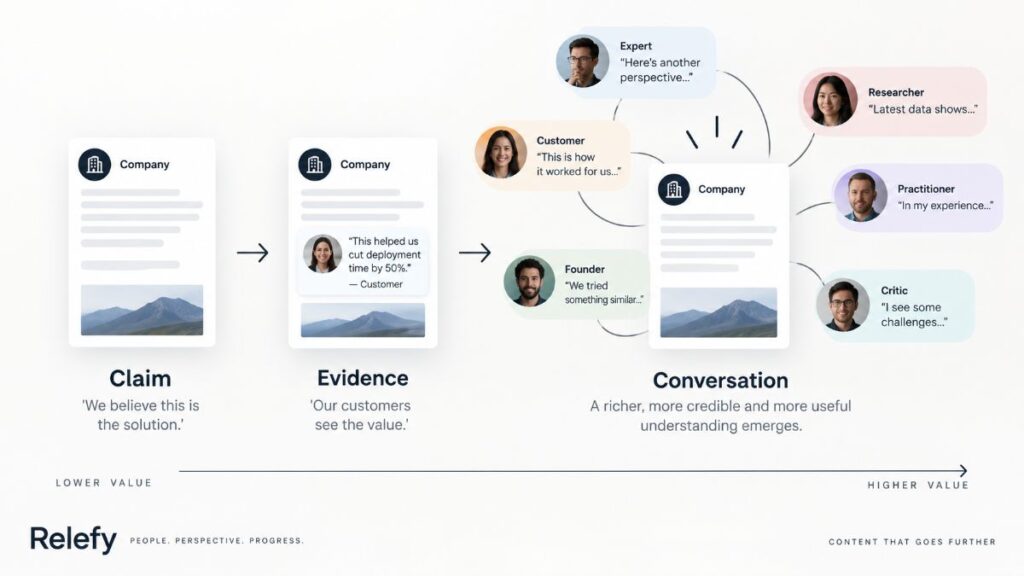
This is the next step from what we argued last week in Why Your Customers Are More Believable Than You. That piece moved from claim to evidence: a company says something, and a customer demonstrating it makes it believable. The next move is from evidence to conversation.
Conversation here does not mean comments, likes or reposts. It means genuinely independent people adding evidence, experience, disagreement or interpretation that the company couldn’t supply itself. Most company content is built as a message: polished, complete, finished the moment it goes live. The content worth making works more like infrastructure. Its value comes less from what it says than from what other people can build on it.
Start with why a company talking alone hits a ceiling. Marian Friestad and Peter Wright, consumer researchers, described the mechanism in their Persuasion Knowledge Model. People accumulate knowledge about persuaders’ goals and tactics, and use it to cope with persuasion attempts. A company writing about its own category is always read through that filter. The reader asks what the company wants before asking whether the claim is true.
A 2025 study by Abigail Bergman, Mohamed Hussein, Rhia Catapano and Zakary Tormala suggests that arguing harder doesn’t escape the filter. Its finding is in its title: providing many arguments increases perceptions of both expertise and persuasive intent. The more one voice argues, the more it looks like it is trying to persuade.
Buyers aren’t short of that kind of content anyway. Gartner’s research on B2B buying, presented by Brent Adamson (co-author of The Challenger Sale), found that nine in ten B2B buyers rate the information they encounter during a purchase as high quality. Their problem is volume and contradiction. When buyers face too much conflicting high-quality information, they are 153% more likely to settle for a smaller, less disruptive purchase than originally planned. One more well-made company message adds to the pile. What buyers lack is help working out what to believe.
Something different happens when the voices are genuinely separate. In the 1980s, the social psychologists Stephen Harkins and Richard Petty studied what they called the multiple source effect. In their experiments, the same information received more scrutiny when it came from several sources than from one.
That scrutiny cut both ways. Strong arguments from multiple sources produced more favourable thinking and more agreement, and weak arguments from multiple sources produced the opposite. Their explanation is the heart of this piece: people assume several sources draw on different perspectives and independent pools of knowledge, so each one is worth taking seriously.
That rules out the obvious misread. This is not an argument for testimonials, paid influencers or a carousel of quotes from friendly partners. As later researchers summarised their work, the effect disappeared when the sources were presented as members of the same committee. Voices that are visibly coordinated register as one voice. A conversation only counts if the other participants could have said something the company didn’t want to hear.
The second misread is that conversation means neutrality. The research points the other way. Meta-analyses by Mike Allen in 1991 and Daniel O’Keefe in 1999 found that messages which raise opposing arguments and answer them persuade best. Messages that mention the other side and leave it unanswered persuade least, below simply arguing one side. The company’s job is not to step back. It is to hold a clear point of view, invite challenge and respond to it.
The clearest example of content working as infrastructure comes from Puppet, a company that sells infrastructure automation software. According to Nigel Kersten, then Puppet’s CTO, Puppet approached Gene Kim in 2012, when Kim was about to publish the IT novel The Phoenix Project. Kim brought in Jez Humble, co-author of the book that defined continuous delivery. More than 4,000 technical professionals completed their 2012 survey, and the first State of DevOps report followed in 2013.
That year, a chance meeting at a conference brought in Nicole Forsgren, an academic researcher who studied the impact of IT. The group produced the reports through 2017. Their work fed into the book Accelerate, and Alan Shimel of DevOps.com later described it as far and away the most widely cited research in the DevOps field.
The research then outgrew the company that started it. Forsgren, Humble and Kim formed their own research firm, DORA. In April 2018, DORA ended its research partnership with Puppet and began producing the report with Google Cloud. In December that year, Google acquired DORA. Puppet continued its own State of DevOps reports with a new team.
That is the honest cost of the model. A real conversation is not something you own. What Puppet got in return was, for five years, its name on the research its market used to reason about its own problem.
The same logic works at the scale of customers. GitLab, which sells a software development platform, keeps its product roadmap and feature-request issue trackers public, so customers and community members can see what the product team is prioritising. When a customer raises a request privately, GitLab’s account managers add a comment to the relevant public issue with generic details about the customer, while the account record stays private in the CRM. The company says a noisy feature request with lots of customer comments is a good thing. A prospect evaluating GitLab doesn’t have to take its word about where the product is going or whether it listens. They can read the thread and see other customers’ needs, their disagreements, and the company’s responses.
In all three cases, the company kept a clear point of view and contributed something only it had: operational data, a research programme, a roadmap. Independent people then added what the company couldn’t: analysis, expertise, customer experience. The original piece became more valuable because of what was built on it.
What makes those conversations work is relevance, and relevance cuts twice. First, it decides which conversation a company has a legitimate reason to be in. Backblaze runs drives, Puppet sold to the teams its survey measured, and GitLab’s roadmap is its product. A company that opens a conversation outside its real knowledge has nothing for anyone to build on.
Second, it decides who belongs in the conversation. Harkins and Petty’s effect depends on sources bringing independent knowledge that bears on the question. A random voice is independent but adds nothing. Last week’s piece showed why evidence lands hardest when it comes from someone like the reader, in a situation they recognise. The same holds here. The right participants are the people whose experience or expertise bears on the reader’s actual decision, including the ones likely to disagree.
This is also why the model is a discipline rather than a trick. The extra scrutiny that rewards strong material punishes weak material. A company that builds a conversation around a thin idea will watch knowledgeable people take it apart in public.
That changes what content is for. A message is judged by who received it: views, clicks, read time, leads. Infrastructure is judged by what gets built on it. What evidence, experience or disagreement did others add that the company couldn’t? Did a new interpretation emerge? Did the piece connect people whose knowledge belonged together? Did the result help someone understand a real decision better than the original piece alone?
For a B2B company, the practical shift is small in wording and large in effect. “What should we post about?” produces messages. The better question is: what conversation do we have a legitimate reason to start or contribute to? The second follows immediately: whose knowledge does that conversation need?
An accounting software company could publish anonymised patterns in how its customers close their books, then invite controllers who do it differently to explain why. A cybersecurity vendor could open incident data to independent researchers. A recruitment firm could publish what candidates actually say when they turn down offers, and ask hiring managers to respond. In each case the company contributes something only it has and accepts that the best-qualified contributors may disagree. The point is not engagement. It is helping an audience understand something that matters to a decision they actually face.
Look at the last ten pieces your company published. How many were messages, and how many gave someone something worth building on?
Sources
Backblaze (2015). Reliability Data Set for 41,000 Hard Drives Now Open-source. Backblaze Blog.
Backblaze (2021). Using Machine Learning to Predict Hard Drive Failures. Backblaze Blog. See also Amram, M. et al., “Interpretable predictive maintenance for hard drives.”
Neural Computing and Applications (2024), hard drive failure prediction using the Backblaze dataset.
Backblaze Drive Stats, Q1 2026 snapshot.
Friestad, M. & Wright, P. (1994). The Persuasion Knowledge Model: How People Cope with Persuasion Attempts. Journal of Consumer Research, 21(1), 1–31.
Bergman, A., Hussein, M. A., Catapano, R. & Tormala, Z. L. (2025). Fifteen Reasons You Should Read This Paper: How Providing Many Arguments Increases Perceptions of Both Expertise and Persuasive Intent. Personality and Social Psychology Bulletin.
Gartner (2019). Gartner Reveals New B2B Sales Approach to Win in Today’s Information Age (press release); Smarter with Gartner, “Why B2B Sellers Need a Sense Making Sales Strategy.”
Harkins, S. G. & Petty, R. E. (1981). The effects of source magnification of cognitive effort on attitudes. Journal of Personality and Social Psychology, 40, 401–413; (1987). Information utility and the multiple source effect. Journal of Personality and Social Psychology, 52(2), 260–268. Committee effect as summarised in Association for Consumer Research proceedings, “Source Independence in Multiple Source Advertising Appeals.”
Allen, M. (1991). Meta-analysis comparing the persuasiveness of one-sided and two-sided messages. Western Journal of Speech Communication; O’Keefe, D. J. (1999). How to handle opposing arguments in persuasive messages. Communication Yearbook, 22, 209–249.
Kersten, N., account of the State of DevOps report’s origins, via DX newsletter, “The history of DORA.”
DORA (2018). DORA and Google Cloud to collaborate on DevOps research. DevOps.com.
DORA (2018). DORA Joins Google Cloud. dora.dev.
Wikipedia, “DevOps Research and Assessment.”
DevOps.com, DevOps Chat with Nicole Forsgren.
GitLab (2021). How to incorporate private customer needs into a public product roadmap. GitLab Blog.
Related Relefy coverage
Why Your Customers Are More Believable Than You (18 September 2026)