
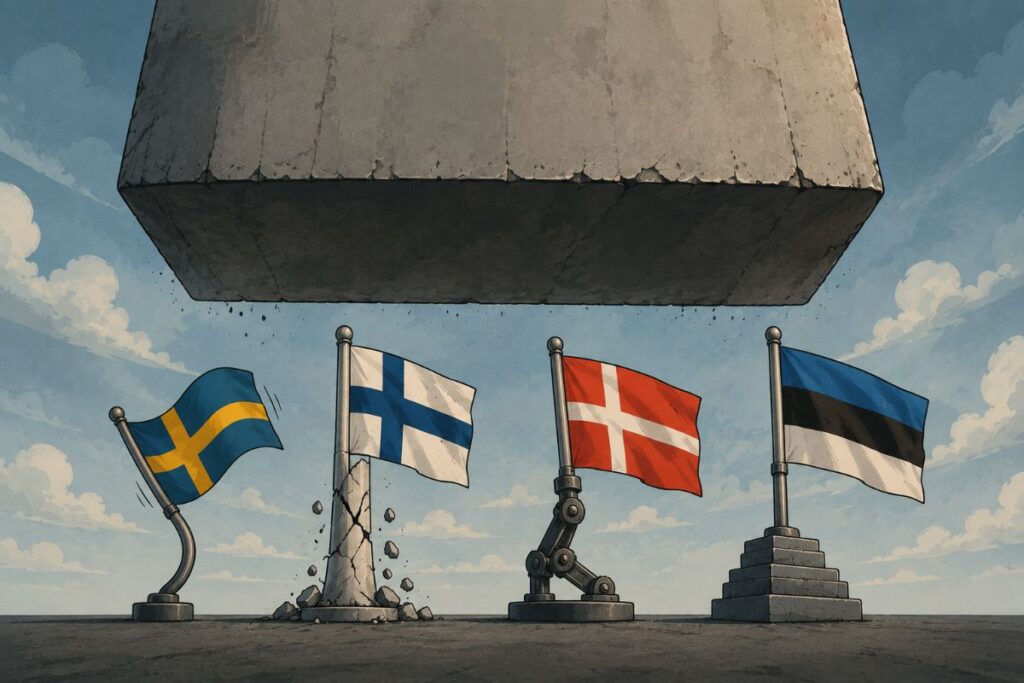
Sweden is being called the world’s most surprising capitalist makeover. Finland is cutting benefits it cannot afford and watching its opposition count the days until they can restore them. Denmark reformed its operating logic decades ago and largely moved on. Estonia started from zero and built lean by deliberate choice.
Four countries. Similar starting pressures. Wildly different outcomes.
The debate about welfare states, public spending, and the size of government is usually framed as a left-right argument. That framing is almost entirely useless. The more interesting question isn’t which side is right. It’s why some countries change in ways that stick, and others don’t.
The answer has almost nothing to do with ideology and almost everything to do with institutional architecture.
Sweden: Reform That Changed the Building, Not Just the Furniture
Sweden’s story is frequently misread as a political conversion. It wasn’t. It was a feedback loop working.
From the 1960s onward, the Social Democratic Party raised taxes and spending until government consumed roughly 70% of GDP by the early 1990s. The result was a decade of weak growth, stagnant incomes, ballooning deficits, and ultimately a banking crisis. Under pressure from investors, the government reformed. Unemployment benefits were cut. Housing subsidies reduced. Public services privatized. Wealth and inheritance taxes eliminated. Strict limits imposed on government debt, which now sits around 33–36% of GDP compared to roughly 122% in the United States.¹
The outcomes are measurable. Total public social spending — including healthcare, education, and all welfare payments — has fallen to 24% of GDP by one comparable accounting measure, similar to the United States and well below France and Italy’s 30-plus percent.² Healthcare spending per capita grew around 1% annually on average between 2014 and 2024 after adjusting for inflation, roughly half the UK’s pace and a third of the US pace.³ Sweden saw more than 500 initial public offerings in the decade through 2024, more than Germany, France, the Netherlands and Spain combined, according to a 2024 report on Europe’s economy by former European Central Bank President Mario Draghi.⁴ It has moved ahead of the United States in billionaires per capita, driven by a technology startup ecosystem that produced Spotify, Minecraft, and Candy Crush.
The top income tax rate has fallen from nearly 90% in the 1980s to close to 50% today. The finance minister has cut taxes three years running.
None of this happened because Sweden’s political class had an ideological awakening. It happened because the data arrived and the correction followed. What matters is what came next.
The reform didn’t just cut spending. It created new institutional actors with a vested interest in the new system. Nearly half of primary healthcare clinics are now privately owned. One in three public high schools is privately run, up from 20% in 2011. School operators are listed on the stock exchange. Private hospital groups talk about KPIs and lean management. A healthcare app called Kry, launched in 2015, now has more users in Sweden than Netflix. Virtual appointments are available around the clock; doctors speak multiple languages including Arabic.
These aren’t just policy changes. They’re structural changes. New companies exist whose survival depends on the new model continuing. New investors have money in the new architecture. New professionals have built careers inside it. The reform created its own defenders, not out of ideology but out of interest. That’s what makes it durable.
There are real costs. Inequality is rising in a historically egalitarian country. Gang violence has surged in immigrant-heavy suburbs. For-profit schools face legitimate criticism for cutting corners. The train network has been neglected. These are genuine problems worth solving, and the political debate about how to solve them is healthy. But they are problems inside a reformed system, not evidence that the reform was wrong.
Finland: Cutting Spending Inside an Unreformed Architecture
Finland is in a different situation, and the difference is structural.
Finland’s general government expenditure reached 57.5% of GDP in 2024, among the highest in the OECD.⁵ From 2022 through the first three quarters of 2025, GDP grew at an inflation-adjusted 0.0%. The EU triggered an excessive deficit procedure. Defense costs are rising. The population is aging faster than most of its Nordic peers.
Prime Minister Orpo’s government is cutting. Benefits are being reduced. Social assistance is being tightened. The government has pushed through more than 20 reforms to weaken the negotiating power of trade unions. It’s doing this not because there is broad ideological consensus that the welfare state was too large, but because the math left no alternative.
That distinction is everything.
Finland’s welfare state was built inside a tripartite negotiation architecture: every major reform agreed between unions, employer associations, and government. This structure is not a policy. It is the operating system the policies run on. It is deeply legitimate, 70-plus years old, and defended by every major institutional actor in the country, including many who don’t consider themselves ideologically committed to big government. They are simply doing their jobs, and their jobs require the architecture to remain intact.
The current government is cutting spending inside that architecture. It is not dismantling it. The unions are still there. The employer associations still expect to be consulted. The civil service still assumes tripartite negotiation as the default. The opposition is openly counting down to the next election, at which point they have promised to restore much of what has been cut.
They will probably succeed, not because Finns are more ideologically committed to big government than Swedes, but because the machinery for restoring the old system will never be dismantled. The moment fiscal pressure eases, normal operations resume. Finland’s reform is a correction under duress. Sweden’s was a restructuring by conviction. The difference determines whether the change sticks.
What would real reform look like in Finland? The same thing Sweden did: create new institutional actors inside the new system before the old ones recover. Private healthcare at scale. School operators with market incentives and stock market listings. New companies whose existence depends on the new model. New architecture. New defenders. That work is slower, harder, and more politically costly than cutting a budget line. Nobody in the current Finnish government appears to be thinking at that level.
Denmark: The One That Changed Its Logic
Denmark solved a different part of the problem.
Rather than simply cutting spending, Denmark redesigned the incentive structure inside its labor market through what became known as flexicurity. Employers gained genuine freedom to hire and fire without the procedural burden that makes European labor markets rigid. Workers received generous unemployment support and aggressive retraining programs. The system accepted the reality of economic disruption rather than trying to prevent it.
This is structural reform. It didn’t just reduce spending. It changed what the system was optimizing for, shifting from protecting existing jobs to enabling people to move between them. The architecture itself was reformed.
Denmark also moved away from the tripartite negotiation model earlier and more completely than Finland. It is the most liberal Nordic economy in terms of direct state intervention, and it has the fiscal room to show for it. Public debt is low. The fiscal framework is strong. Economic growth is healthy. The welfare state remains generous by international standards but is organized around incentives rather than entitlements.
Denmark’s lesson is that the question isn’t the size of the state. It’s the logic of the state. A large welfare state built around flexibility and retraining is fundamentally different from one built around permanent protection. One is compatible with a dynamic economy. The other is not.
Estonia: Built Lean by Necessity, Defended — and Now Tested — by Choice
Estonia is the outlier that clarifies everything.
In 1991, Estonia declared independence from the Soviet Union. It had no institutional architecture to dismantle because it had no institutional architecture at all. No entrenched unions with 70 years of legitimacy. No tripartite negotiation model embedded in law and practice. No civil service culture built around a particular vision of the state’s role. It built from zero.
What it built was lean. Estonia’s tax code has ranked first among OECD countries in the International Tax Competitiveness Index for ten consecutive years. Corporate taxes apply only to distributed profits: reinvested earnings face a 0% rate. Businesses spend an average of 5 hours dealing with corporate income taxes annually, compared to 42 hours in most OECD countries.
The results match the architecture. Estonia produced one of Europe’s fastest growth rates since independence. It is home to more unicorn companies per capita than almost any country in the world.
What makes Estonia genuinely interesting is what happened when defense spending pressures arrived. With Russia’s ongoing aggression in the region driving up security costs, Estonia faced a genuine fiscal test. Its response was deliberate — and instructive about institutional character. Parliament initially legislated a temporary “defense tax” mechanism, but then abolished it in June 2025, choosing instead to make permanent increases to income tax (from 22% to 24%) and VAT (from 22% to 24%), effective 2026.⁶ The logic: temporary levies with sunset clauses introduce structural uncertainty; permanent, simple, broadly based tax increases are more compatible with the existing architecture’s core design principles. The flat tax remains flat. The reinvestment exemption on corporate profits remains intact. Estonia raised the price of its lean model to pay for security — it did not abandon the model to do so.
Whether that choice proves durable under continued pressure is the open question. But the fact that the debate was framed in those terms — how do we fund defense within our existing architecture, rather than using defense as justification to expand the state — is itself meaningful.
The Question Underneath All of This
These four cases are not really about welfare states. They are about feedback loops.
Sweden received feedback from the market and the data in the 1990s, acted on it, and rebuilt an architecture that created new interests aligned with the new model. The reform stuck because it changed who benefits from the system continuing.
Denmark received feedback earlier and redesigned the logic rather than just the budget. The reform stuck because the underlying incentive structure changed.
Finland is receiving feedback now, under duress, without the political or institutional consensus to make structural changes. The reform is real but fragile because nothing in the architecture has changed.
Estonia never built the heavy architecture. It is defending leanness as a conscious choice in the face of real pressure, while adjusting the price of that choice. The reform is durable because the people who would undo it never had the institutional base to do so.
Norway is the case that proves nothing. Its sovereign wealth fund, now valued at approximately $2.2 trillion,⁷ insulates the welfare state from the fiscal pressure that forces correction everywhere else. Norway can afford not to confront the question. That’s not a model. That’s geology.
The pattern is clear: what makes reform durable isn’t the ideology of the government that implements it. It’s whether the reform creates new institutional actors who have a material interest in defending it. Ideology changes with elections. Institutional interest is much harder to dislodge.
The Practical Takeaway
If you are watching this debate from the outside, the useful question is not which party has the right position on public spending. It is: what does the institutional architecture of your country actually incentivize?
Cutting a budget line changes a number. Changing an architecture changes what is possible. The Nordic countries that changed their architectures are in different positions from those that only changed their numbers. That gap will widen as demographic pressure, defense spending, and slow growth continue to tighten the fiscal environment across Europe.
Sweden built new institutions. Denmark changed the logic. Estonia defended its starting position while funding new obligations within it. Finland is still fighting inside the old structure.
Same pressure. Four outcomes. The difference was never the ideology.
Sources
Sweden debt-to-GDP ~33–36% of GDP; US at ~122%: IMF Fiscal Monitor data via Georank.org (2026). Note: the article’s original figure of 36% is drawn directly from the Wall Street Journal (May 2026), which used a slightly earlier IMF dataset; current figures sit marginally lower.
Sweden social spending at 24% of GDP: Wall Street Journal, Tom Fairless, “The World’s Most Surprising Capitalist Makeover Is Under Way in Sweden,” May 2026. This figure reflects a specific accounting methodology covering healthcare, education, and all welfare payments on a comparable basis with the US; on standard gross OECD measures Sweden’s public social expenditure is higher (~27–28% of GDP per Statistics Sweden / IndexBox, March 2026).
Healthcare spending per capita growth 2014–2024 (~1% annually, adjusted for inflation): OECD data, as cited in Wall Street Journal, May 2026.
Sweden 500+ IPOs over 10 years through 2024, ahead of Germany, France, Netherlands and Spain combined: Mario Draghi, “The Future of European Competitiveness,” European Commission, September 2024, as cited in Wall Street Journal, May 2026.
Finland general government expenditure 57.5% of GDP (2024): OECD, Government at a Glance 2025 — Finland country note.
Estonia tax changes 2025–2026 — defense tax mechanism abolished June 2025, income tax and VAT permanently raised to 24%: EY Tax Alert, “Estonia abolishes temporary defense tax, increases several tax rates,” July 2025; TaxRavens, “Estonia Income Tax 2026,” February 2026.
Norway sovereign wealth fund ~$2.2 trillion (end-2025): Norges Bank Investment Management, Fund Value; CNBC, February 2026.