
From 2027, Being First in Finland’s Grid Queue Stops Counting
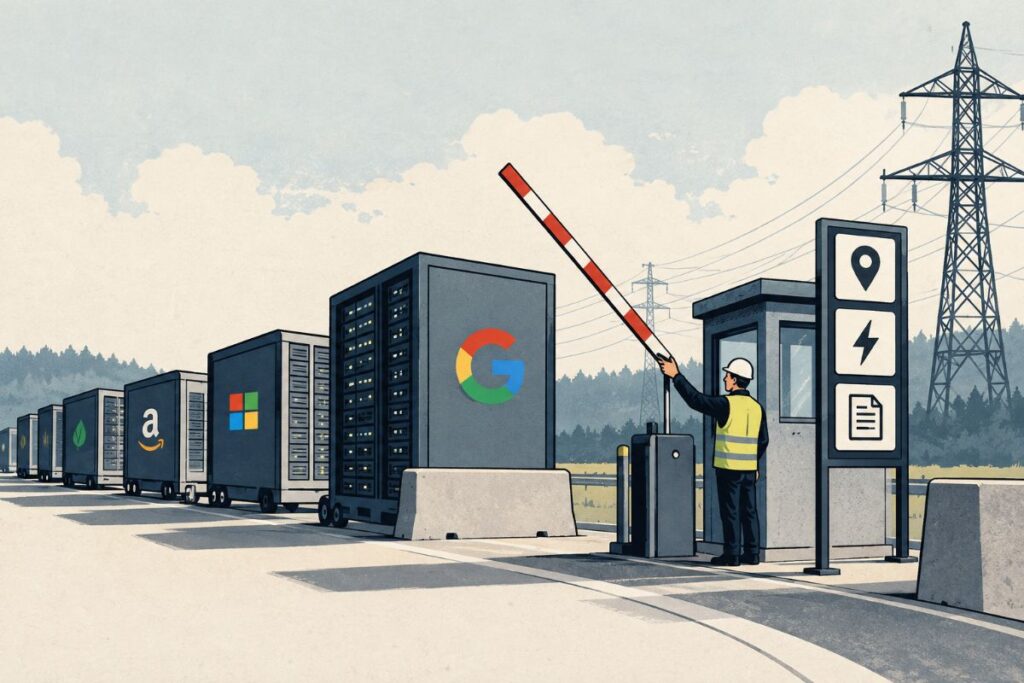
For anyone who follows Finland’s data center boom, the announcement date is about to become the least useful date in a project’s life.
Today, Fingrid, the national grid operator, and the regional network companies sign connection agreements in the order requests arrive. A draft amendment to the Electricity Market Act, prepared by the Ministry of Economic Affairs and Employment (TEM), would end that from 1 January 2027 (Valtioneuvosto, 18 Sep). The consultation closed on 9 October. If the law passes in anything like its current form, a large data center’s place in line will depend mainly on where it sits on the grid and whether it brings flexible power. Those are the formal criteria. Beside them sit constraints the grid law does not touch, above all environmental permits, and this week showed they can decide a project’s timing just as much.
The obvious misread is that Finland is closing the door on data centers. It is not. The draft keeps network companies’ obligation to connect everyone, and it changes nothing about who has the right to connect. What it changes is the order in which scarce capacity is offered, and in which the grid is built out, when not everyone can be served at once.
That order would come from four priority groups, set by connection size and use (Castrén & Snellman, 24 Sep). Households, small sites up to 3 MW, data centers up to 1 MW and sites critical to society go first, still in order of arrival. Data centers of 1 to 10 MW sit in the second group with other sites up to 100 MW. Data centers above 10 MW land in the third group, alongside sites above 100 MW, unless they commit flexible generation covering at least 80 percent of their peak load. Variable wind and solar do not count as flexible. Storage charged from the grid comes last.
Groups two to four would be handled in batches twice a year. Within a group, a site where capacity is available ranks first. After that comes the size of a flexibility commitment, and then a production commitment, under which a site covers at least half its annual consumption from a specific power plant commissioned within the previous 36 months in the same grid area. The project’s development stage is also taken into account (Castrén & Snellman, 24 Sep). The rules would also cover pending requests that have no connection agreement yet, and the first batch must be processed by 31 December 2027. According to Yle, Fingrid’s own capacity map currently shows no free connection capacity in southern Finland (Yle, 10 Oct).
The ministry does not hide that the rules single out one industry. Tatu Pahkala, the TEM industrial counsellor behind the draft, told Yle that the sheer number of data center projects and how fast they can invest justified what he called mild unequal treatment. Unlike industries tied to a port or a raw material, the argument goes, a data center can choose a site where the grid has room. Denmark and Ireland, where data centers stand further back still, were the models, and the trigger was a flood of new connection applications to Fingrid over the summer. Pahkala expects the law to delay some projects, perhaps by years: without that effect, he said, no priority order would be needed (Yle, 10 Oct).
Fingrid wants the law in place on schedule. Jussi Jyrinsalo, the Fingrid executive in charge of grid planning, says the need is clear and urgent, and that fast connections are a competitive advantage Finland wants to keep. Fingrid also wants the flexibility commitment tightened so that it brings genuinely new flexible capacity, and it warns that a data center selling waste heat to district heating should not qualify as critical to society (Fingrid, 9 Oct; Fingrid statement). Jyrinsalo expects more data centers to locate outside southern Finland, pointing to Google’s planned sites in Kainuu and North Ostrobothnia (Yle, 10 Oct).
Datakeskusteollisuus, the Finnish Data Center Association, wants the draft sent back. In its statement, as reported by Kauppalehti, it calls the 10 MW threshold for data centers, against 100 MW for other users, discrimination without measurable grid grounds. It argues that the procedure could freeze connection processing and investment for almost a year during 2027, and that projects could move to Sweden and Norway (Kauppalehti, 13 Oct). Its alternative is a maturity screen: capacity only for projects that can show permits, bank guarantees or binding power purchase agreements. The draft already weighs development stage, but only within a group; the association wants maturity to come first. Antti Poikola, its executive director, sees no basis for picking out one industry, and says a company that has already bought a plot and then cannot get a large enough connection would see the project killed (Yle, 10 Oct).
The association is not alone on the thresholds. The Finland Chamber of Commerce asks for the same limits for data centers as for everyone else and for batches at least quarterly (Keskuskauppakamari, 9 Oct). Technology Industries of Finland has reservations about sector-specific limits too (Teknologiateollisuus, 13 Oct). Finnish Energy, the network companies’ association, backs the groups in the main but wants prioritisation kept as a last resort behind building more grid (Energiateollisuus, 8 Oct). A different objection comes from Polarnode, a data center developer: in practice, flexible capacity often means gas or diesel engines, and Polarnode warns that favouring them will increase the use of fossil fuels (Yle, 10 Oct).
One question is open and should be read as such. Datakeskusteollisuus says the draft conflicts with EU non-discrimination rules and with the Finnish constitution. The ministry’s consultation request takes the opposite view: EU law does not require first-come, first-served connections, only rules that are non-discriminatory, transparent and based on objective technical and economic criteria (consultation request, 18 Sep). Whether a different threshold for one industry meets that test is exactly what is disputed.
Measured against its neighbours, Finland is not an outlier. Ireland, where data centers take a far larger share of electricity, adopted rules last December that apply to data centers alone. Above 10 MVA, a new site must bring new dispatchable generation or storage matching its full import capacity, cannot ramp up until that capacity is delivered, and must cover 80 percent of its annual demand with new Irish renewables within six years (CRU, Dec 2025; EirGrid, May 2026). Ireland applied those rules to new applications only, while Finland’s draft would also reach requests already in the queue, which is the root of the industry’s fear of a stall. In Denmark, the grid operator Energinet paused new connection agreements for three months this spring, naming data centers as a main driver (IN Power, 8 May).
Sweden and Norway, the markets Datakeskusteollisuus calls more predictable, have mostly kept queue order and tightened maturity tests instead. Svenska kraftnät says its maturity requirements alone removed 14,300 MW from its queue, most of it generation rather than consumption (Svenska kraftnät, 2 Feb). Statnett has proposed requiring zoning, proof of financing and operation within six years for loads of 100 MW or more (Statnett). Finland’s draft sits between the two models: stricter than Sweden on who goes first, much softer than Ireland on what a data center must bring.
The law is still a draft, due to go to parliament this autumn (Iltalehti, 13 Oct). This week’s projects already show how its criteria, and the constraints outside it, would sort announced investments. Location and flexibility are the two criteria the grid rules write down. Environmental permitting is not part of them at all.
Location comes first, and the week’s largest announcement shows why it matters. On 8 October Sesterce, a French AI infrastructure company, announced a campus of more than €10 billion at the former Kaipola paper mill in Jämsä, starting with 200 MW and rising to 600 MW (Sesterce, 8 Oct). The site already has a high-voltage connection to the regional network company Elenia, which says that connection is a solid foundation for the first phase. It says nothing about the second, and the release does not say whether the first phase needs more capacity than the existing connection provides. If it does not, the new queue rules matter less for it. How far along the project is remains unclear: chief executive Youssef El Manssouri told Yle the investment decision is made and a customer contract signed, and that reusing an industrial site should not cause biodiversity loss (Yle, 8 Oct), while the company’s own release speaks of plans and leaves the anchor customer unnamed.
Flexibility is the second criterion, and here Sesterce offers something the draft does not reward. Its pledge is to enable 1 MW of new renewable generation for every MW the campus uses, within ten years of the campus becoming operational. That adds energy over a decade. The draft moves a site up a group only for flexible capacity, which excludes wind and solar. A production commitment improves a site’s place within its group, but it must name a specific plant, commissioned within the previous 36 months, covering at least half of annual consumption. Sesterce’s pledge, as announced, names no plant and runs over ten years, so on our reading it would not lift a large campus out of group three. Ireland asks for both firm capacity and renewables, and for the firm capacity before the site may ramp up.
Environmental permitting is not a grid criterion, but it can stop a project that has what the grid rules ask for. Google’s two new sites show how. Google announced on 9 September at least €13 billion of investment in Finland, and its new sites at Muhos in North Ostrobothnia and Kajaani in Kainuu are in the regions Fingrid itself cites as the alternative to the congested south. Google puts the cleared area at 330 hectares in Muhos and just under 200 hectares in Kajaani (Yle News, 13 Oct). The clearing went ahead while the environmental impact assessments for both projects were still unfinished.
The permit trail explains how. At the end of March, Google applied to Muhos municipality for a landscape works permit for groundworks. The municipal building inspector, Eero Airaksinen, asked the Finnish Supervisory Agency (LVV), which said the permit could not be granted while the assessment was incomplete. Airaksinen told Helsingin Sanomat that after months of talks, and what he described as heavy pressure from Google’s lawyers, he accepted their reading that certain preparatory works could start under a provision of the Building Act; he also said he was not sure what the law required and does not know whether he acted correctly (Ilta-Sanomat, 10 Oct). In June the municipal building control told Tuike Finland, Google’s Finnish subsidiary, that certain preparatory works were possible under the Building Act; according to Ilta-Sanomat, this was not a formal permit decision. On 6 October LVV told Tuike Finland to halt works that significantly alter the environment at both sites by 23 October at the latest, until the assessments are complete (Ilta-Sanomat, 13 Oct).
In its response to LVV, dated 11 October, Tuike Finland confirmed it has stopped the works, acknowledged “possible deficiencies” in their compliance that it says were unintentional, and warned that some stabilisation work may be needed after the deadline, which it says it would carry out only with the authorities’ prior written approval (Ilta-Sanomat, 13 Oct; STT via Maaseudun Tulevaisuus, 12 Oct). Two days later Antti Järvinen, Google’s country director in Finland, apologised in his first media interviews on the case. He said the company acted on its best understanding of the law and that authorities knew of its plans, but declined to say which authorities. He denied that Google had pressured the municipality, saying no lawyers from Google’s side attended the meeting after which the permission was given, and he rejected negligence or inexperience as explanations (Yle News, 13 Oct).
The consequences so far are procedural. Environment Minister Sari Multala (National Coalition Party) says current law allows no direct sanction for skipping the environmental assessment, though a missing assessment can be grounds to appeal a permit, and tighter rules are before parliament (MTV Uutiset, 9 Oct). Oulu police have opened a preliminary inquiry into the Muhos works (STT via Maaseudun Tulevaisuus, 12 Oct). We covered how the case unfolded last week in Finland Had the Rule. It Took Seven Months to Apply It.
None of this sits in the grid queue. Google has a long-term power agreement with Fortum, which we examined in Finland Is Building Data Centers Faster Than It Is Deciding Who Gets the Power, and it chose regions with grid room. It is the environmental procedure that has set the pace. If the grid rules work as intended and push more large projects out of the south, more of them may land on undeveloped land in the north, where procedures like the one now applied to Google carry more weight. Kaipola’s brownfield site points the other way.
Utajärvi, also in North Ostrobothnia, shows the criteria and the constraints running on different clocks. On 9 October the construction company NYAB said it had signed for the first preparatory works on a planned 200 MW campus there, starting immediately (NYAB, 9 Oct). The developer, Data Tank Nordic, a project company of AMP Tank AG, is still applying for a research permit for the two underground cable routes that would link the data center and a battery storage system to Fingrid’s Utanen substation, with comments open until 6 November (Maanmittauslaitos, 30 Sep). Nothing in that is improper. It simply means site work and grid access are moving separately, and from January the grid side follows a calendar the developer does not set.
For anyone whose work follows these projects, that changes what to watch. A press release says who wants to build. The dates that will say who actually builds, and when, are the batch rounds, the connection agreements and the permit decisions, and they run on separate tracks. Fingrid will brief the market on its updated connection principles and terms on 23 October, the same day LVV’s deadline for Google runs out (Fingrid, 9 Oct).
The rules are meant to send large users where the grid has room and to make them bring flexibility where it does not. When the first batch is processed, will the projects at the front of the line be the ones Finland most wants, or the ones that happened to be best placed when the rules changed?
Sources
- Valtioneuvosto: Sähköverkkoon liittämisen etusijamenettely lausuntokierrokselle (18 Sep 2026)
- TEM: Consultation request VN/24069/2026 (18 Sep 2026)
- Castrén & Snellman: Ehdotettu sähkömarkkinalain etusijamenettely (24 Sep 2026)
- Yle: Käänne: Datakeskukset siirretään sähköjonon hännille (10 Oct 2026)
- Fingrid: Sähköverkkoon liittämisen etusijamenettely tarvitaan nopeasti käyttöön (9 Oct 2026)
- Fingrid: Statement on the draft government proposal
- Kauppalehti: Sähkölakiin tulossa pikamuutos – Raivo repesi datakeskusalalla (13 Oct 2026)
- Keskuskauppakamari: Lausunto sähkömarkkinalain muuttamisesta (9 Oct 2026)
- Teknologiateollisuus: Lausunto sähkömarkkinalain muuttamisesta (13 Oct 2026)
- Energiateollisuus: Lausunto liittymistarjousten käsittelyn etusijamenettelystä (8 Oct 2026)
- Sesterce: Sesterce Plans a €10 Billion AI Campus in Jämsä (8 Oct 2026)
- Yle News: Sesterce plans €10bn data centre project in Central Finland (8 Oct 2026)
- Ilta-Sanomat: Tällaisen hävityksen Google jätti Muhokselle (13 Oct 2026)
- STT via Maaseudun Tulevaisuus: Google on toimittanut vastineen hakkuista (12 Oct 2026)
- MTV Uutiset: Datakeskuskohu: Google voi välttyä rangaistukselta (9 Oct 2026)
- NYAB: Sopimus datakeskushankkeen valmistelutöistä Utajärvellä (9 Oct 2026)
- Maanmittauslaitos: Ilmoitus tutkimuslupahakemuksesta, Utajärvi (30 Sep 2026)
- Yle News: Google Finland head apologises for forest clearances at data centre sites (13 Oct 2026)
- CRU: Large Energy Users Connection Policy, CRU/2025236 (12 Dec 2025)
- EirGrid: Data Centre Connection Offer Process and Policy v3 (May 2026)
- IN Power: Energinet pauses new Danish grid connections (8 May 2026)
- Svenska kraftnät: Nära 5000 MW nya anslutningar beviljades 2025 (2 Feb 2026)
- Statnett: Strengere modenhetskrav for forbrukstilknytninger ≥ 100 MW (2026)