What just changed
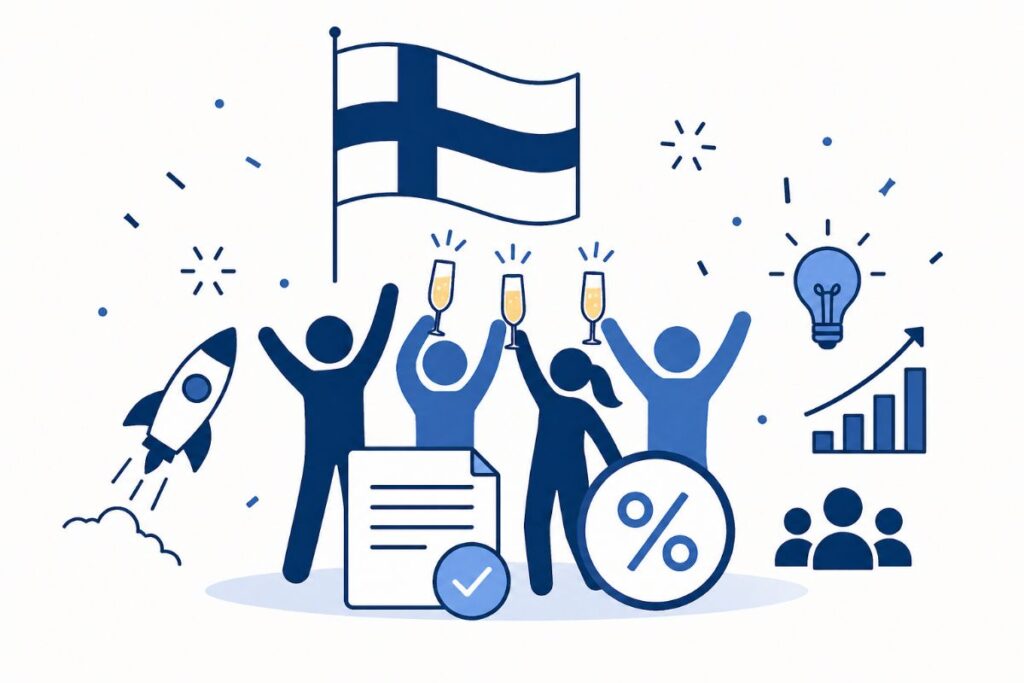
The Finnish Startup Community announced that going forward, employee stock options in startups will be taxed only at the point when the shares are sold — that is, when the employee has received actual cash. The reform also means that employees working in group structures can receive options in the parent company, an important improvement for internationally operating growth companies.
That ends the situation that made Finnish options functionally dangerous for employees: exercise your options, own shares worth €80,000 on paper, owe €40,000 in income tax immediately, cannot sell the shares, and must pay from personal savings or walk away from the options entirely.
The reform removes a key flaw in the current model, as the Finnish Startup Community stated: employees may have been required to pay taxes already at the point of exercising their options, even if they had not yet sold the shares or received any cash. This created uncertainty and led many to refrain from using their options altogether.
Meet the people who fought for this
This reform did not happen by itself. It took a specific group of people pushing for years — in formal government submissions, in public statements, at every political opportunity available. These are the ones who made it happen.
Riikka Pakarinen — Finnish Startup Community CEO
Pakarinen has been the policy voice of Finnish startups since becoming CEO of the Finnish Startup Community at its founding in October 2021. The community was founded by 100 Finnish growth companies and venture capital investors, with Pakarinen as its first CEO. Early members included Aiven, Smartly, Supercell, and Wolt.
Option tax reform was on her agenda from the start. The Finnish Startup Community explicitly listed it as one of its most central goals, arguing that Finland must become the world’s best destination for international talent.
On the day of the announcement she said: “This is a long-awaited and very important decision for Finnish growth companies. Employee stock options are a key way to attract talent to help build new success stories. The taxation model now finally reflects the reality in which startup employees operate. This decision significantly strengthens Finland’s position in that competition. In the long term, the reform may also increase tax revenues if more startups succeed and scale.”
Timo Ahopelto — Lifeline Ventures, Finnish Startup Community board chair
Ahopelto is a founding partner at Lifeline Ventures, a Helsinki-based early-stage venture capital fund established in 2009. He is a serial entrepreneur and co-founder of CRF Health, a Finnish e-clinical unicorn, and has been deeply active in the Finnish startup ecosystem through Slush, ETLA/EVA, and the Finnish Startup Community.
As chair of the Finnish Startup Community’s board, Ahopelto gave the campaign its heaviest institutional weight. His response to the announcement: “Truly wonderful that this is now being corrected in the right direction.”
Ilkka Paananen — Supercell co-founder and CEO
Paananen is the most visible face of Finnish startup success globally, and he has used that platform deliberately. In February 2025, he was one of the first signatories of the EU Inc petition calling for unified startup rules across Europe, including on how companies are taxed and how employees receive equity. He told YLE: “EU countries have vastly different approaches to taxing shares and stock options offered to employees — a common practice in the startup world.” He argued the success of technology startups is critical for Europe and its welfare society.
Paananen is not just a figurehead. He is Finland’s most prominent demonstration that startup equity creates enormous tax revenue — when the system works. When Supercell succeeded, its founders became among Finland’s largest individual taxpayers for years running. The ecosystem that produces that outcome needs the right incentive structure to keep producing it.
Miki Kuusi — Wolt co-founder
Kuusi was among the first Finnish signatories of the EU Inc petition calling for unified rules for startups across Europe, including on equity and taxation. He has been Finland’s highest earner and top taxpayer for three consecutive years — 2022, 2023, and 2024 — with income tied to the stock incentive programme from Wolt’s acquisition by DoorDash.
Kuusi’s story makes the case better than any policy paper: a Finnish startup built a global company, was acquired for $8.1 billion, and generated hundreds of millions in Finnish tax revenue. The question is how many more Wolts Finland is capable of producing — and how many engineers chose Tallinn instead of Helsinki because the option maths didn’t work.
Not Optional — Index Ventures’ pan-European campaign
The international pressure came from Not Optional, the campaign founded by Index Ventures and backed by over 700 CEOs, founders, and investors.
The campaign’s country rankings told Finland’s story in unambiguous numbers. Finland scored 13 out of 30. The Baltic states — Estonia, Latvia, Lithuania — each scored 30. The UK scored 29. Even Germany, which had previously been near the bottom, overhauled its system in 2024 and jumped to 25. Finland sat in the bottom tier, listed as “ripe for change” — one of the few countries that had “made no meaningful progress in stock option reform.”
Over five years the campaign drove reform across eleven countries — France, Germany, the UK, Austria, Spain, Latvia, Lithuania, the Netherlands, and others. Finland watched country after country fix its system while staying stuck.
A Helsinki-based founder put the stakes plainly. Sabrina Maniscalco, CEO and co-founder of Algorithmiq, said: “Enterprise Management Incentives are available in the UK but not in Finland. When it comes to attracting top talent in the tech space, the simplicity and benefits of a less fragmented approach is appealing.”
Minister Arto Marttinen — the politician who delivered
The Finnish Startup Community specifically thanked Minister of Employment Marttinen for advancing the matter and ensuring the startup sector’s perspective was heard in the preparation process. Reform needs an internal champion. Marttinen was the one who carried it through the coalition.
Why it took ten years — and who held the line
The Income Tax Act orthodoxy. Under Section 66, Subsection 3 of Finland’s Income Tax Act, the benefit from employee stock options had been classified as taxable earned income since 1995 — the same category as monthly salary. That classification survived for three decades. The idea that illiquid, high-risk equity in an unlisted startup might deserve different treatment was structurally resisted.
Legislation built for the wrong era. Finnish startup-based firms now employ approximately 47,000 people globally — comparable in scale to the entire domestic forest sector workforce. But when the relevant rules were written, startups were a rounding error. Finnish legislation was designed for large industrial employers paying regular salaries.
The labour movement objection. Parts of the trade union movement argued consistently that equity compensation is compensation, and compensation should be taxed as income. The principle is not wrong. The outcome — taxing illiquid, unsellable shares before any cash changes hands — was absurd in practice. But the principle had political weight, and it slowed reform at every coalition negotiation.
Fiscal caution. Every finance ministry is cautious about changes that reduce near-term tax revenue. The argument for reform — better incentives produce more startups that eventually produce more tax revenue — is correct but long-dated. The Finnish Startup Community’s own submission made this point: the current system flaw leads to options being left unexercised, meaning tax revenues are also lost. The argument was persuasive. It just took time.
What the scoreboard looked like
Estonia has topped the Not Optional rankings globally with a perfect score of 30. Tax at sale. Flat rate. No liquidity trap. The Estonian Parliament specifically made taxing employee stock options more flexible to encourage the startup community.
Sweden introduced qualified employee stock options in 2018, under which qualifying companies can grant options taxed as capital gains — generally 25% for shares — only when the employee sells.
The UK’s Enterprise Management Incentive scheme results in no income tax or National Insurance at exercise. Employees can claim Business Asset Disposal Relief at a reduced 18% rate on qualifying gains.
Germany — which previously sat near the bottom of the same ranking — introduced its Future Financing Act in 2024, deferring taxation to the point of sale for qualifying companies, and jumped from last place to 25 out of 30.
Finland: income tax at exercise, marginal rate above 50%, no cash available, tax due immediately. Score: 13 out of 30.
The engineers knew this. Every time a Finnish startup made an offer and a candidate compared it to the Tallinn or Stockholm alternative, Finland lost quietly and without headlines.
The celebration is earned
Finnish startups already generate over €12.5 billion in revenues and employ nearly 50,000 people globally — up from just over 30,000 in 2020. This ecosystem was built despite the liquidity trap, not because of it. Now it gets to grow without it.
The people who pushed for ten years — Pakarinen making formal government submissions, Ahopelto lending institutional credibility, Paananen and Kuusi lending public visibility, Not Optional publishing the rankings that made Finland’s position untenable — they won.
One important caveat remains. According to Borenius, based on current information, employee stock options will remain subject to earned income taxation at progressive rates reaching above 50%. The key change is deferral of that tax to the point of sale — not a shift to capital gains treatment. Detailed legislation is expected by summer 2026.
The direction is unambiguously right. The final rate will determine whether Finland merely stops punishing builders — or actually starts rewarding them the way Estonia, Sweden, and the UK do.
The startup community is celebrating. It should also be in the room when the legislation is written.