The empty waiting room isn’t a warning. It’s a signal.
On an ordinary Wednesday, occupational health psychologist Matti Jaakkola sits in room 09 on Aleksanterinkatu in Porvoo. His chair is in the corner. The client’s chair is across a small table with tissues on it — for tears or a runny nose.
Lately, neither chair has been occupied.
Jaakkola wrote about it on LinkedIn with striking honesty. AI, he said, has learned to give decent answers to the questions his clients used to bring him. Sleep problems. Anxiety. Workplace conflict. The barrier to getting help dropped to zero — phone in hand, any hour, no appointment needed. So people stopped booking. Client volumes at occupational healthcare psychology practices have fallen 5–10% in 2026.
He went for a longer run. Opened the golf simulator. Started building a new website.
That response is right. But it doesn’t go far enough.
The number that makes no sense next to an empty chair
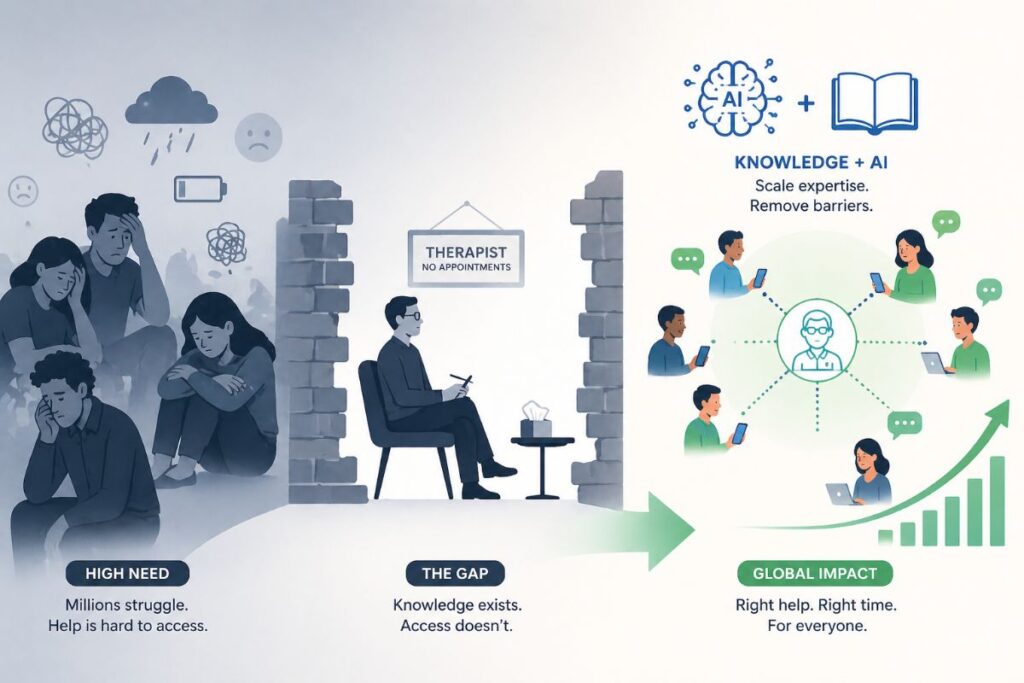
Finland is in a mental health crisis by any reasonable measure.
Mental health challenges cost Finnish society €11 billion per year. 55% of all disability pensions are granted due to mental health issues. A third of young people report that work feels too demanding.
Globally, the picture is the same or worse. Depression and anxiety disorders have risen sharply across OECD countries. Waiting times for mental health support stretch months in most European systems. In many parts of the world, professional support is simply not accessible at any price.
So we have a psychologist with an empty calendar sitting inside one of the worst mental health crises in Finnish history, inside a global demand curve pointing straight up.
That is not a technology disruption story. That is a distribution problem.
AI didn’t take his clients. It served the ones who never came.
Here’s what actually happened in room 09.
The person who used to book an appointment for mild anxiety, sleep issues, or a difficult conversation at work — that person found a faster, lower-friction answer on their phone. They didn’t replace Jaakkola. They were never really his client in the first place. The occupational healthcare system, employer contracts, referral requirements, and physical locations had already filtered them out. AI just made the filtering visible.
This is the Jevons paradox applied to mental health. When the cost of access drops — when anyone can get a decent answer about sleep hygiene at 2am without leaving home — demand doesn’t shrink. It expands. People who never sought help before start seeking it. Some of them will find that AI is enough. Many will discover they need more.
The question is whether that “more” leads anywhere useful, or hits another wall.
It’s also worth noting that Finland’s current unemployment crisis — the highest in the EU at 10.6% — is being driven by construction and services, not AI. The technology is currently changing what people do at work, not who gets hired or fired. But the entry-level door is quietly closing in knowledge work, and mental health is not immune. The restructuring hasn’t fully arrived yet. The time to build the new model is before it does.
Finland’s actual position
Before writing this off as a problem for someone else to solve, consider what Finland actually has.
Decades of clinical research and practice in a system that has been stress-tested by genuine population-level demand. High-trust institutions. A culture that has been forced, through necessity, to develop real-world knowledge about what works and what doesn’t in mental health intervention at scale. English-language capability to operate internationally. And a domestic crisis that has generated more applied learning than most countries will accumulate in a generation.
That is not a liability. That is a 20-year head start on a problem the rest of the world is only beginning to face seriously.
As Nandan Nilekani and R. Venkatesan argued in the context of India’s AI opportunity: the most transformative impact of AI will come not from using it but from building with it — and the greatest gains go to those who deploy it to enhance human expertise rather than replace it. The same logic applies here. Finnish mental health expertise is not the bottleneck. The delivery model is.
The opportunity nobody is building toward
Global mental health demand is structurally undersupplied. The constraint has never been knowledge — it has always been access, trust, and distribution. AI removes the first barrier. It does not remove the need for genuine clinical expertise, human judgment, or the kind of conversation that actually changes something.
What it creates is a triage layer. AI handles the entry point — the 2am question, the first acknowledgment that something is wrong, the basic psychoeducation. The professional handles what the professional alone can do — diagnosis, complex intervention, crisis response, the work that requires another human in the room.
That is a different service model than a psychologist waiting in room 09 for employer-referred clients. It is a model that scales across borders, reaches people who currently reach nobody, and deploys Finnish clinical expertise against a global problem that is not going away.
The chair doesn’t need to be in Porvoo. It doesn’t need to be a chair at all.
The question worth asking
Jaakkola’s LinkedIn post ended with a question: has your work decreased because of AI?
The better question is: what would your work look like if AI handled everything it can handle, and you focused entirely on what only you can do — at whatever scale the model allows?
Finland has the crisis data, the clinical depth, the research base, and the institutional credibility to build that model before anyone else does. The empty waiting room is not evidence that the need has gone away.
It’s evidence that the need has outgrown the room.
Think you have the solution? Comment below. Know someone building in this space? Share this with them.
Sources: Iltalehti / Matti Jaakkola · Suomen Uutiset / Mental health crisis · Helsingin Sanomat / Unemployment · Fortune / Jevons paradox · Economic Times / AI and productivity