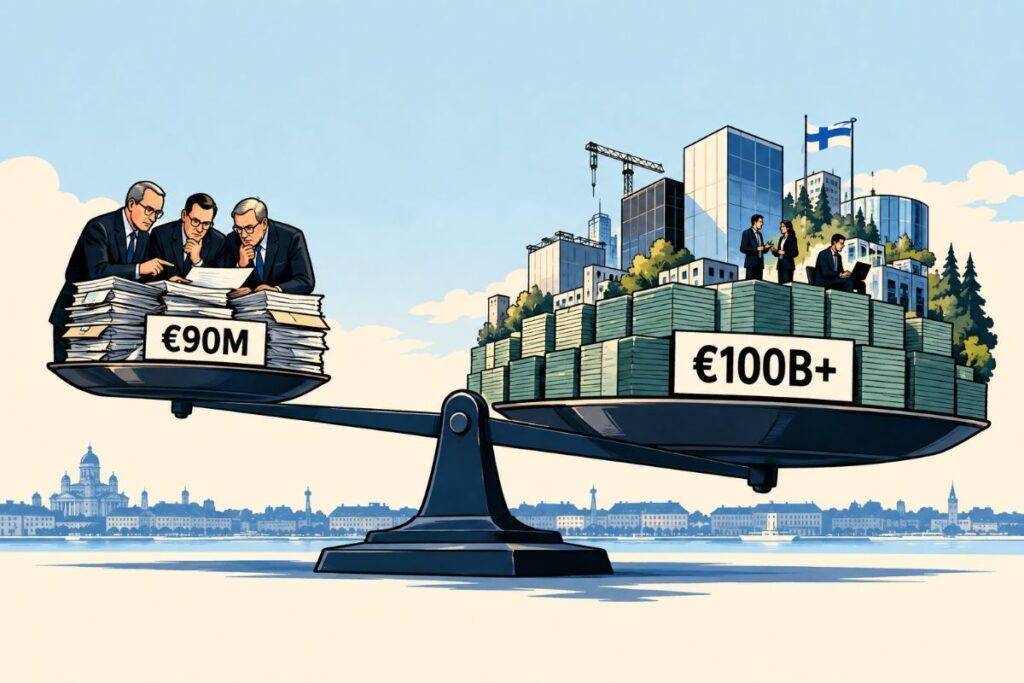

Finland joined NATO in April 2023. Most of the coverage focused on what that meant geopolitically — the border with Russia, the shift in European security architecture, the end of decades of military non-alignment.
Less discussed: what it means for Finnish builders.
The answer is becoming clearer. A market that was effectively closed is now open. And the window won’t stay quiet for long.
The numbers first
Finland’s defense budget stood at $6.8 billion in 2025. The government’s plan takes it to $11.5 billion by 2032 — roughly 3.3% of GDP, well above NATO’s 2% guideline. Finland has since committed to reaching 3% of GDP by 2029. Defense NewsBreaking Defense
That trajectory isn’t just a line item in a government budget. It’s a procurement signal. When a government commits to spending at that scale and pace, it needs suppliers. And the traditional defense industry — slow, consolidated, built around decade-long procurement cycles — can’t move fast enough on its own.
That’s where startups come in.
The NATO dividend is already showing up in revenue
A Tesi survey identified 368 companies operating in Finland’s indigenous defense sector, of which 144 were designated as fast-growing startups and growth companies. Dual-use companies — those offering solutions for both civil and military use — are reporting revenue growth of 30–40% since NATO accession. Defense News
Dual-use is the key word. Companies building in communications, surveillance, autonomy, logistics, and AI don’t need to choose between civilian and defense markets. NATO membership means both doors are open simultaneously.
Finland’s defense tech sector now numbers 368 companies, and at Slush 2025, Finland’s Defense Forces procurement chief signaled a clear shift: traditional long acquisition cycles are giving way to faster, more modular engagements. Since 2022, the defense sector has received more than €4 billion in supplemental funding, with defense procurement last year alone topping €2.9 billion. ComplexDiscovery
The infrastructure is being built right now
This isn’t theoretical. The access points are already active.
VTT launched Finland’s first NATO DIANA accelerator in Espoo in early 2026, with ten technology themes including advanced communications, autonomy and unmanned systems, resilient space operations, and data-assisted decision making. Applications from all NATO member countries are open until July. VTT
DEFINE — the Defence Innovation Network Finland — runs a separate accelerator from Riihimäki, free of charge, no equity taken, open to startups and SMEs from NATO countries. Its Spring 2026 batch is already underway. Definefinland
Two accelerators. Both running now. Both free. Both plugged directly into NATO procurement networks.
The honest challenge
The opportunity is real. The entry cost is also real.
Defense procurement — even the accelerated version — runs on certification, security clearances, and interoperability standards. Ukraine’s experience is instructive: their internal platforms allow companies to go from concept to battlefield deployment in months. NATO systems typically require 3–5 years for certification. That gap hasn’t disappeared. It’s just narrowed enough that startups with the right technology and patience can now get through. ComplexDiscovery
The companies that will win here aren’t the ones that pivot to defense opportunistically. They’re the ones that already have a real technical foundation — and decide to apply it to a market that’s just become accessible.
What the global unicorn data tells us
Look at the 2026 unicorn list. Aalyria, Harmattan AI, Skyryse, ZaiNar — all defense-adjacent, all crossing the billion-dollar threshold in Q1 alone. None of them Finnish. All of them doing things Finnish deep tech companies could compete in: communications networks, autonomous systems, positioning technology, aerospace software.
The category is moving. The capital is following.
Finland has a 1,340-kilometer border with Russia, world-class engineering talent, and NATO membership that gives its companies direct access to the world’s largest defense procurement network.
The question for Finnish builders isn’t whether this market is real. It’s whether they move before someone else fills the space.