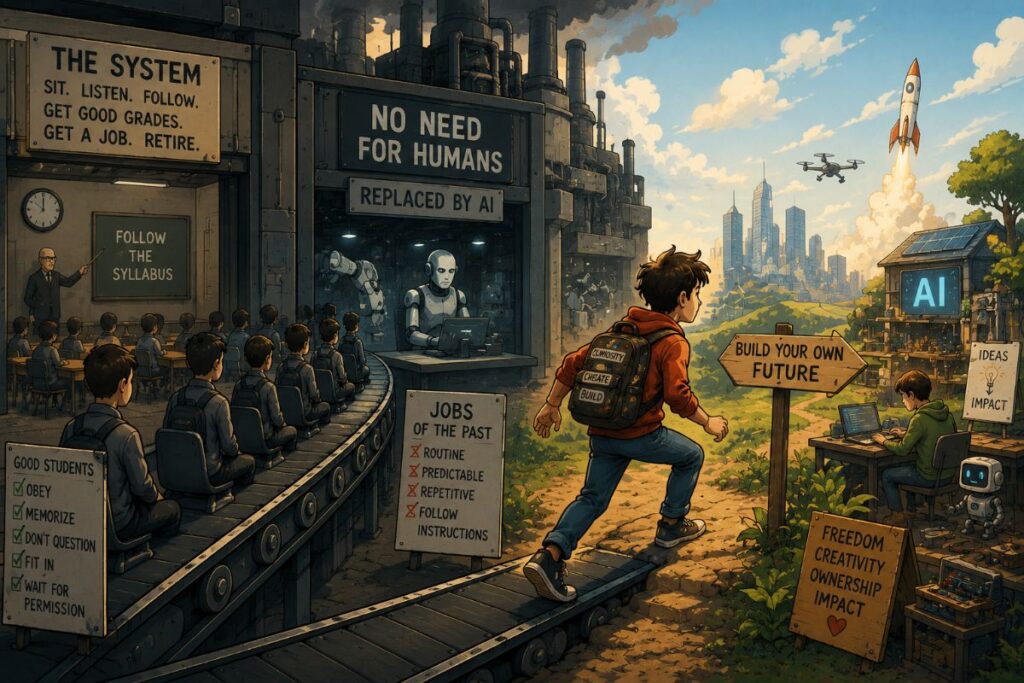
There is a system most people pass through without questioning. Twelve or more years of school. Grades that measure compliance as much as capability. Timetables, bells, standardized outputs. Then a job. Then a career. Then retirement.
It feels natural because it has been there for generations. It is not natural. It was designed. And it was designed for a world that is disappearing faster than the system can adapt.
Why the School System Was Built
In the second phase of the Industrial Revolution, factory owners across England, France, Prussia, and the United States faced a problem. Their machines were becoming more complex. They needed workers who could read instructions, follow processes, show up on time, and do so consistently at scale.
The solution was public education. Not education for its own sake — for theirs. As economists Oded Galor and Omer Moav documented in their research on the period, the human capital capitalists needed included not just literacy and numeracy, but “work habits, such as punctuality, discipline, manners, and diligence.” Manufacturers lobbied governments for universal schooling because, as Leeds iron-master James Kitson explained to a parliamentary committee in 1867: individual manufacturers could not build the system alone, and if they did, others would reap the benefit. They needed the state to do it collectively.
The state obliged. By the end of the 19th century, school enrollment had transformed across the industrialized world. England went from 11% of children aged 5 to 14 in primary schools in 1855 to 74% by 1900. France, Prussia, the United States — the same pattern, driven by the same logic. Capital needed human capital. Capital funded the system that produced it.
The school system was not built for students. It was built for the economy that needed them.
The Economy That Needed Them Is Changing
That arrangement held for over a century. Show up, follow instructions, trade time for wages. Institutions grew around it. Careers were built on it. Entire identities were constructed inside it.
Now the arrangement is breaking.
The Ewing Marion Kauffman Foundation released its annual report on early-stage entrepreneurship in May 2026, tracking 30 years of data from 1996 to 2025. The overall rate of new entrepreneurs increased in 2025 and remained above pre-pandemic levels. But underneath the headline: the opportunity share — the share of people starting businesses by choice rather than necessity — remains below its 2019 pre-pandemic peak and declined again in 2025 for most demographic groups. More people are building, but a growing share are doing so because traditional employment is no longer delivering what it once promised.
The Kauffman researchers track income fragmentation and job stability as pressures driving new business formation. They did not name the cause directly. The direction is not difficult to read.
The 2026 OECD survey of small and medium businesses found that half of all SMEs believe they risk falling behind competitors if they do not adopt AI more aggressively. That is not a technology story. That is a pressure story. The pressure is already being felt at the smallest scale of business operation. At the largest scale, the same technology is being deployed to reduce headcount, lower costs, and increase efficiency.
The system built to produce obedient workers is producing them on schedule. The demand for obedient workers is falling.
This Is Not a Western Story
The most important signal in the data is not American or European. It is global.
The World Bank has tracked formal business registrations across 180 economies since 2006. The pattern is consistent regardless of geography or income level: every major economic disruption is followed by a surge in new business formation. The 2008 financial crisis suppressed registrations briefly, then came the rebound. Covid-19 did the same. In 2021, 92% of economies recorded an increase in new business registrations — the largest single-year spike in the dataset’s history.
People do not start businesses because conditions are good. They start businesses because conditions changed and they adapted.
In Finland, total registered businesses grew from 641,619 in January 2022 to 728,137 in January 2026. More than 86,000 net new businesses in four years. The growth is concentrated in sole traders and small limited companies — the lowest-barrier, most accessible forms. First-time builders, not restructuring corporations.
In the United States, a QuickBooks survey found one in four women plan to launch a business in 2026. Another 58% would consider it. Their stated motivations: higher income, more control, greater flexibility. Not aspiration. Adaptation.
The same pattern appears in Estonia, which grew from 13.2 new companies per 1,000 adults in 2006 to 24.3 by 2022 — the highest rate in the world — not through cultural transformation but through friction removal: free incorporation, one-day registration, digital access for foreign founders. In Cabo Verde, reforms in 2014 triggered a growth from 1.5 new companies per 1,000 adults to 18.5 by 2022 — the biggest increase of any economy tracked.
The desire to build was always there. The system suppressed it. Remove the friction, and people move.
The Threshold Has Never Been Lower
The second force converging with the pressure is the tools.
The 2026 OECD D4SME Survey found that AI adoption among small firms grew from 7.1% in 2023 to 17.4% in 2025. That growth is happening unevenly — large firms are pulling ahead faster, widening the adoption gap to 34.6 percentage points by 2025. But the direction for small operators is clear, and the impact is disproportionate. Among self-employed respondents in Japan, 33% reported significant or transformational impact from AI adoption. That figure was higher than for small firms (27%) and medium-sized firms (22%). The smallest operators are getting proportionally the most from the tools.
A solo founder in 2026 can execute what required a small team five years ago. Marketing, administration, customer engagement, demand forecasting, content, communication — the operational threshold for running something independently has dropped substantially, and it is continuing to drop.
Estonia did not create more ambitious people. It made it easier for ambitious people to act. AI is doing the same thing at the operational level, globally, simultaneously, for anyone with an internet connection.
The Question the Data Is Actually Asking
The school system was designed to produce workers for an economy that needed them compliant and consistent. That economy is being automated. The institutions built around employment — the career ladder, the pension, the organizational identity — are less stable than they were a decade ago and will be less stable still in a decade from now.
At the same time, the barrier to building something independently has fallen to its lowest point in history. The tools are cheaper. The friction is lower. The knowledge is more accessible. The global data shows that wherever that friction falls, people build.
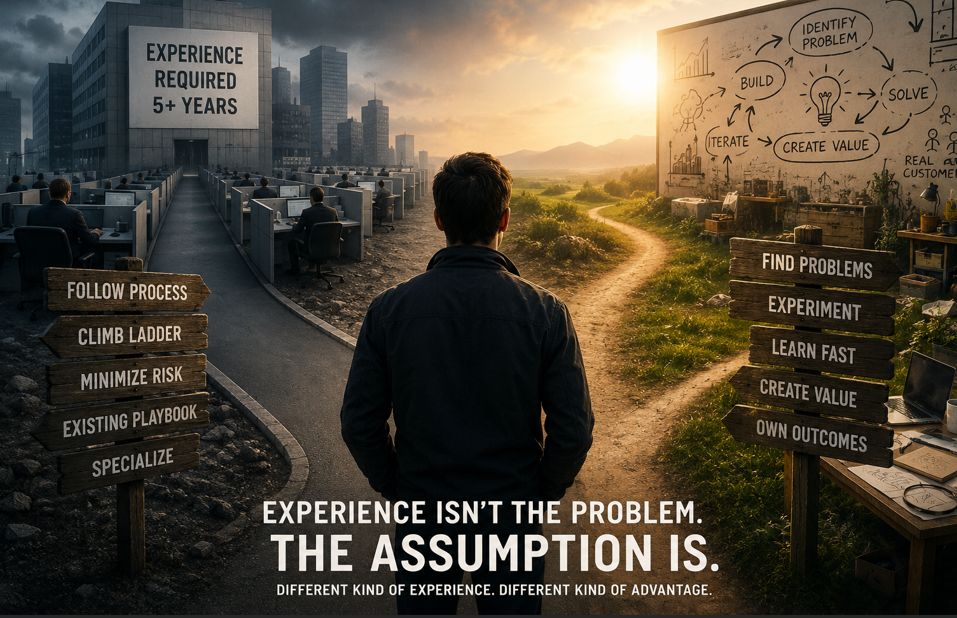
Most people are still operating on the assumption that employment is the stable path and entrepreneurship is the risky one. That assumption was formed inside a system designed to produce employees. It has not been updated to reflect the world that system is now operating in.
The QuickBooks data found that one in five women planning to start a business are still waiting for the timing to feel right. The timing will not feel right. It never does. The people who moved without waiting are already a year ahead.
The Kauffman data found that the opportunity share of new entrepreneurs — those starting by choice rather than necessity — has not returned to pre-pandemic levels. More people are updating their risk calculation than the narrative of entrepreneurship-as-risky-choice would suggest. The calculation is shifting.
The world is not waiting for permission to rebuild itself around a different economic structure. The registrations are already being filed. The sole traders are already operating. The tools are already being deployed by people who were told, for twelve years of school and several more of employment, that their job was to follow instructions.
That instruction is becoming the riskiest one to follow.
Millions of children are in school right now being taught to sit still, follow the syllabus, and wait for permission. The economy they are being prepared for no longer exists. The one they will actually inherit rewards creativity, independent thinking, and the ability to build something from nothing — none of which appear on a standardized test.
The data shows people are figuring this out on their own, after the fact, often out of necessity. The question is whether the system that shaped them will ever catch up — or whether the next generation will spend their first decade of adulthood unlearning what twelve years of school taught them to believe.