There is a version of this debate that Finnish pension funds cannot win. A parliament member stands up and says pension funds should invest more in domestic growth companies because Finland needs it. The pension fund board answers that their legal mandate is to maximize returns for beneficiaries, not to serve national interests. End of discussion.
Hjallis Harkimo, the businessman, former sports mogul, and Liike Nyt party leader, has been making the case loudest. In a parliamentary speech on May 6, 2026 he was direct: only one fifth of pension fund assets are invested in Finland, two hundred billion euros are invested abroad, and that is too little. Harkimo understands the returns argument. He has pointed to the illiquidity premium available in domestic private markets, and to the fact that refusing to build internal capacity for sophisticated direct investment means leaving that premium on the table. He is right about the diagnosis. His proposed solution, legislative mandates directing domestic allocation, still fails, but not because he does not understand the financial case. It fails for a different reason, which the rest of this article addresses.
The argument nobody is making
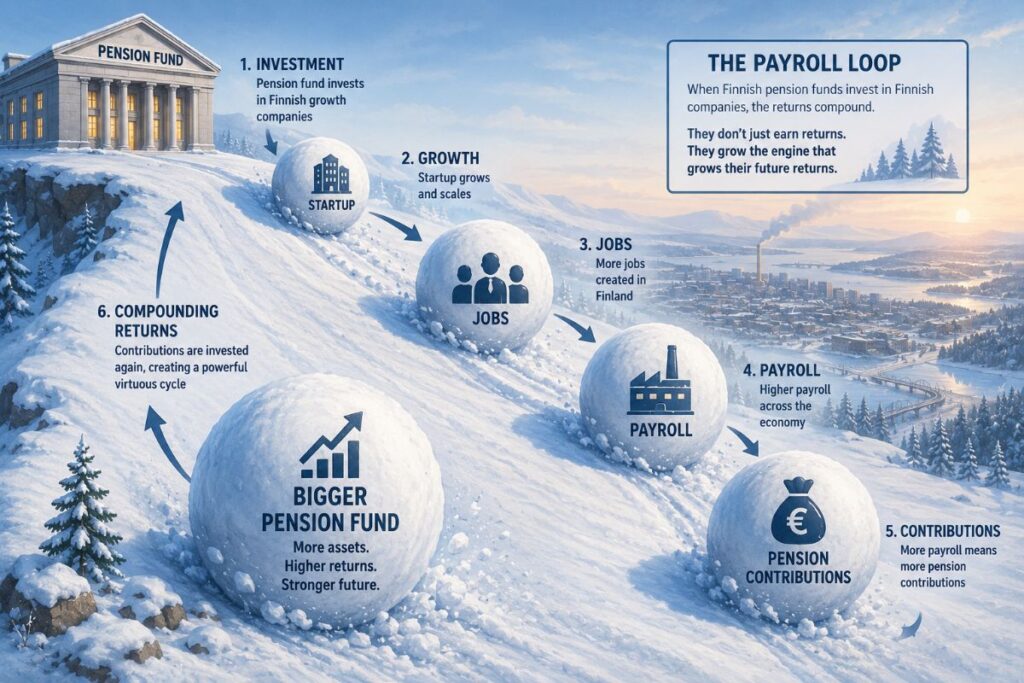
Finland’s earnings-related pension system runs on payroll contributions. When Finnish companies grow, they hire. More people working means more payroll. More payroll means more contributions flowing into the pension system. More contributions mean more assets under management. More assets under management mean more capital generating returns.
A foreign VC fund investing in a Finnish startup hopes for a return on that specific investment. A Finnish pension fund investing directly in a Finnish startup has something a foreign VC fund does not: a structural reason to care whether the company creates Finnish jobs, because Finnish jobs expand the pension fund’s own capital base.
This is not a social policy argument. It is a compounding returns argument. The pension fund that backs the companies creating Finnish payroll is not doing Finland a favor. It is investing in its own supply chain.
There is a second returns argument that gets almost no attention in the Finnish debate. Finnish growth companies are priced at a significant discount to equivalent companies in markets with deeper capital pools. Less capital chasing the same deals means lower entry valuations, which means higher potential returns for a patient investor with the capability to evaluate them. The illiquidity premium that applies to all private market investing is amplified in a market that is structurally undercapitalized relative to its opportunity set. A Finnish pension fund with the governance capability to invest directly in Finnish growth companies is not just getting access to an asset class with superior historical returns. It is getting access to that asset class at prices that reflect a supply-demand imbalance it is uniquely positioned to correct.
These two arguments together, the payroll loop and the valuation discount, are the case that should be leading this debate. Instead the debate runs on obligation and patriotism, which is precisely why it keeps producing the same answer.
When the case for domestic investment is made as a social policy argument it hands the advantage to the status quo. A pension fund board has one legal mandate: generate returns for beneficiaries. The moment you ask them to compromise that mandate for something else, they have every procedural reason to decline. The fiduciary defense is not laziness. It is legally correct. The patriotism argument was always going to lose to it.
The returns data meanwhile does not support the trade-off framing. According to the American Investment Council, which represents the private equity industry, private equity delivered a median annualized return of 13.5 percent over a ten-year period across 200 U.S. public pension funds in 2024, outperforming public equity, real estate, and fixed income. The source has an interest in the conclusion, but the direction of the finding is consistent with academic literature on private equity returns. Finnish pension funds currently invest less than 1 percent in domestic startups. In the UK, pension funds allocate a similarly small share to domestic unlisted equities today, but the government has made a binding commitment under the Mansion House Compact to reach 5 percent of default fund assets by 2030. The gap between Finland and the UK is not today’s number. It is the direction of travel and the institutional commitment behind it.
The debate is not about whether pension funds should sacrifice returns for social good. It is about whether they should stop leaving returns on the table, and whether they understand that returns from Finnish growth companies compound through their own system in ways that returns from Apple stock do not.
But can they actually be good owners?
The payroll-loop argument is compelling. The next question is obvious: even if the incentive is there, can pension funds actually act on it well? Or does the institutional reality produce a government ministry with a checkbook?
This is the question the debate almost never reaches, because it keeps getting stuck on the obligation argument at the entrance.
Studies generally find that firms receiving solely government VC tend to perform worse than those receiving private funds. Fewer investments, less successful exits, higher failure rates. Governments screen companies using criteria other than pure performance, and often lack the selecting capabilities to back the most promising firms. The risk is specific: an institution with a political mandate to support domestic employment has a structural incentive to keep failing companies alive, to avoid exits that would embarrass someone, to hold positions too long. That produces a portfolio that reflects political logic rather than commercial logic.
But this is not a fixed outcome. It is a governance problem, and governance problems have solutions.
Canada’s eight largest public pension funds, the Big Eight, now manage approximately CA$2.7 trillion in assets under what is studied internationally as the “Canadian Model.” Internal management. Economies of scale. Investment professionals hired at market rates. Boards composed predominantly of experienced business and finance professionals appointed through independent governance committees. CPPIB, Canada’s largest pension fund and the most documented of the group, reported a 10-year annualized net return of 9.2 percent as of March 2024. Active management has consistently added value above passive benchmarks across the group.
The Big Eight are not a social policy vehicle. They are a commercial investment operation that happens to be publicly owned. Canadian courts have developed the concept of the pension trustee as a “public fiduciary” whose obligations are defined by what is in the long-term interest of beneficiaries, not what is politically convenient. Fiduciary duty requires loyalty to beneficiaries, and that loyalty explicitly prohibits subordinating their economic interests to unrelated objectives. A fiduciary may never select investments on the basis of any factor outside the economic interest of the plan.
This legal framework is the spine of the Canadian model. It protects the institution from political capture while permitting, even requiring, long-term strategic thinking. A fund that invests in domestic growth companies because it expects superior risk-adjusted returns, including the compounding effect through the payroll loop, is acting squarely within its fiduciary duty. A fund that does so because parliament mandated it has already broken that framework, even if the investment looks identical on the balance sheet.
This is precisely why Harkimo’s legislative mandate approach, however satisfying as political argument, produces the wrong outcome. The mandate removes the commercial discipline that makes the investment work. The institutional culture that follows a mandate is different from the institutional culture that follows a commercial conviction, and that difference shows up in which companies get backed, how they are governed, and when positions are exited.
What is already happening
The payroll-loop insight is not merely theoretical. Pension funds that have acted on something like it have produced measurable results.
A 2026 study published in the Journal of Corporate Finance by researchers David Pinkus, Dario Pozzoli, and Cédric Schneider at Copenhagen Business School analyzed approximately 117,000 unlisted Danish companies. Companies with pension fund investors filed twice as many patents on average. Their R&D employment share was four percentage points higher. The effect strengthened with holding period up to five years and was strongest when pension funds took on long-term ownership and influenced leadership to think more strategically. Their policy conclusion: overly strict limits on how pension assets can be invested restrict the financing of innovative companies.
Across Europe, several markets have moved from argument to action. The UK committed in 2023 to channeling up to £50 billion from pension funds into unlisted equities by 2030, framed as a returns decision. The Netherlands’ PME Pension Fund allocated approximately €400 million for investments in promising Dutch companies in 2026 on commercial terms. Sweden in January 2026 completed the most significant overhaul of its AP buffer fund system in 25 years, merging private equity specialist AP6 into AP2 with parliament explicitly requiring that venture capital expertise be preserved and expanding AP2’s rights to invest in unlisted assets until 2036. The IMF’s 2024 working paper on European VC named Finland’s own Tesi as a model for channeling pension capital into domestic growth companies through funds of funds.
The UK example also contains a warning. By June 2026 the language had shifted from pension funds allocating to a higher-returning asset class to ministers calling for “bigger risks with taxpayer-backed investments” to protect national champions, with direct government stakes taken in Wayve, Kraken, and Oxford Quantum Circuits. The Mansion House Compact was a returns argument. London Tech Week was a national interest argument. The slide from one to the other is exactly what happens when political pressure replaces commercial conviction as the organizing logic.
Finland has some of the infrastructure already in place. Elo has backed Lifeline Ventures four consecutive times since 2016, and Lifeline’s latest €400 million fund has produced Supercell, Wolt, Oura, ICEYE, and Aiven. Those are not charity investments.
But investing through VC funds is not the same as direct investment, and the distinction goes to the heart of the argument. A VC fund is incentivized to maximize returns on its specific fund. It has no stake in whether a portfolio company creates Finnish jobs, pays Finnish payroll taxes, or expands the Finnish pension contribution base. The fund manager’s carried interest does not compound through Finnish employment the way pension fund AUM does. Backing Lifeline is a sound investment decision. It is not the same as a Finnish pension fund sitting directly on the cap table of a Finnish scaleup, using its ownership position to influence where the company builds, hires, and lists.
The structural alignment of incentives that makes this argument uniquely compelling applies only to direct investment. A Finnish pension fund investing directly in a Finnish growth company may be the only investor in the ecosystem whose economic interests are structurally aligned with Finnish employment growth. Foreign VC funds want returns on their fund. Domestic VC funds want returns on their fund. Neither compounds through the payroll base. The Finnish pension fund does. That is a different incentive structure, and it is one that no other investor class shares.
What structural commitment actually requires
This is where the argument has to land harder than it usually does in policy discussions, because the logic is precise: The payroll loop is strongest when the pension fund holds the ownership stake directly. The moment that stake is delegated to a VC intermediary, the chain breaks. The VC captures the financial return. The pension fund captures a share of it. But the structural incentive, the compounding through Finnish employment into Finnish pension AUM, belongs only to the direct investor. Investing through funds is better than not investing. It is not the same argument.
This means the governance capability required is not optional. It is the condition under which the unique argument holds at all. A Finnish pension fund that outsources its domestic growth investment to VC funds is making a reasonable portfolio decision. It is not acting on the structural incentive this article describes. To act on that incentive requires building what the Canadian funds built: internal investment teams with genuine sector expertise, direct deal sourcing capability, and the governance framework to make and hold commercial decisions without political interference.
Specifically: a ring-fenced vehicle with a dedicated team, separate from the main portfolio and its existing governance logic. Investment professionals hired from the VC and growth equity industry, not promoted from within. Return targets that reflect the actual risk profile of growth-stage direct investment. The institutional tolerance to hold positions through underperforming periods and exit positions that are not working, without treating either decision as a political event.
The IMF’s working paper adds one further structural condition: public institutions should invest alongside private sector co-investors, contributing less than half of any round. The goal is to crowd in private capital, not replace it. This also functions as a discipline mechanism: if the pension fund cannot attract a commercial co-investor to a deal, that is information about the deal.
Harkimo’s instinct about leverage is right. A pension fund writing a significant check directly into a scaleup can negotiate terms: the facility gets built in Finland, the company lists here. That is not charity. It is the normal exercise of investor leverage, and it is only available to the direct investor. The fund-of-funds investor does not have that conversation. The VC fund manager has it on behalf of all their LPs, with no particular reason to use it in Finland’s interest.
The deeper point
The most durable public arguments are the ones where someone eventually makes the incentive case rather than the obligation case. The obligation argument is easy to make and easy to refuse. The incentive argument requires more work to construct but is much harder to dismiss.
Finland’s pension fund debate has been running on obligation. Harkimo is making it loudly. Rahapodi is amplifying it. The pension executives are correctly deflecting it. The debate will keep producing the same result until someone makes the incentive argument clearly enough to change the frame.
The incentive argument is this: Finnish pension funds are uniquely positioned, more than any foreign VC, more than any passive index, more than any domestic VC fund whose incentives stop at the fund level, to benefit from Finnish employment growth in ways that compound through their own system. That is not a moral claim. It is a structural fact about how the pension system works. Acting on it directly, with the right governance and internal capability, produces returns and employment simultaneously because the incentives point in the same direction. Acting on it through mandates produces neither reliably. Outsourcing it to intermediaries who do not share the incentive captures only part of the return and none of the compounding.
Finland is having the right conversation in the wrong language. The capital is not the obstacle. The argument is.
Sources: IMF Working Paper WP/24/146 · Bank of Canada, Large Canadian Public Pension Funds · CPPIB 2024 Annual Report · Waitzer and Sarro, Canadian Bar Review Vol. 91 · Pinkus, Pozzoli, Schneider, Journal of Corporate Finance 2026 · American Investment Council Public Pension Study 2025 · PME Pension Fund · Sifted, Mansion House Compact · CityAM, Kendall/Kyle · Finnish Startup Community / Business Finland · Elo / Lifeline Ventures · European Pensions, Sweden AP fund reform · Harry Harkimo, parliamentary speech 6.5.2026 · Rahapodi podcast