
A new integrative review in the journal Businesses, Is Business Planning Useful for Entrepreneurs? A Review and Recommendations, covering 87 studies and three decades of research, set out to answer a simple question: does business planning help entrepreneurs? The conclusion, stated plainly, is yes. Planning improves survival, profitability, and growth. The recommendation is direct: start planning seven to twelve months before launch, and keep doing it. Twelve months? There are founders who have founded and exited entire companies in less time than that!
Read past the conclusion and a different picture appears. The studies behind it were not built to answer the question a small, founder-led team actually has. They were built to answer a question banks, venture capitalists, and government agencies have. And the seven-to-twelve-month figure itself turns out to be the clearest tell of all.
Who the research is actually about
Pull apart the samples and the pattern is consistent, and it has nothing to do with team size. Burke et al., one of the review’s central studies, surveyed 422 firms averaging 2.88 employees, where 27% had already secured bank loans at founding. A bank loan requires a document. That isn’t evidence a plan caused survival, it’s evidence a plan is the price of entry the bank charges. Perry’s sample had a median of four employees and an average company age of eleven years; the finding there was a weak positive effect on reducing bankruptcy, in firms old enough to already be dealing with creditors. Honig and Karlsson studied entrepreneurs in Sweden whose business plan completion was a prerequisite for government grants, and in that same study found no correlation between the plan and the venture’s actual profitability or survival.
These are not solo-founder samples versus team samples. They’re nearly identical in size to a founder plus one or two co-founders plus an early hire. The variable that actually separates the studies isn’t headcount. It’s whether an institutional gatekeeper sits between the venture and its money. Even the review’s own meta-analysis admits the planning effect is “more pronounced in established firms than in start-ups.” The throughline: nearly every positive finding traces back to a bank, a VC, or a grant office wanting a document to justify a decision, which is what Kirsch et al. found when they studied 722 VC funding applications and concluded the plan’s content didn’t actually move the decision, its role was ceremonial.
That same gatekept world is where the money concentrates today. Crunchbase data from May 2026 shows that through April, 80% of new U.S. venture investment went into rounds of $500 million or more, spread across just 29 companies. That’s the population the planning literature is sampling, even when its conclusions get applied far beyond it.
The clock is the giveaway
Look closely at where “seven to twelve months” comes from. It traces to Hopp and Greene’s study of firms with a mean age of 21 months at the time of measurement, already past the point where a bank or an investor was likely involved. The timeframe isn’t describing how long it takes to learn something true about a market. It’s describing how long it takes to produce a document thorough enough to survive a gatekeeper’s scrutiny.
Compare that to what a real test of an assumption actually takes. Kevin Dwoskin’s wife drank a glass of A2/A2 dairy and felt nothing, after years of intolerance. That took minutes, not months, and it was the entire hypothesis test behind the company that followed. Caroline Lynch put $200 into jewelry supplies and opened an Etsy shop; the market answered within days, not quarters. Neither hypothesis needed a twelve-month runway to resolve. It needed a customer.
Scale that logic up to the largest company in the sample, and it still holds. Amazon, with a market cap above $2.6 trillion in mid-2026, one of the five most valuable companies on earth, runs on the opposite of a twelve-month planning cycle for most of its decisions. Jeff Bezos built Amazon’s entire decision-making culture around what he calls one-way doors and two-way doors. A one-way door, a decision that’s hard or costly to reverse, deserves the careful, deliberate process the planning literature is actually describing. But Bezos has said most decisions are two-way doors, reversible, and his stated rule is to make those with around 70% of the information available, because waiting for 90% means moving too slowly. A trillion-dollar company with full institutional legitimacy, full access to capital, full audiences of analysts and shareholders, still treats most of its decisions as something to test and reverse in weeks, not something to plan for a year. If the most resourced company in the index doesn’t operate on a twelve-month planning clock for the decisions that actually move it, the case for imposing that clock on a five-person team with no gatekeeper to satisfy gets harder to make, not easier.
Startups search. Companies execute.
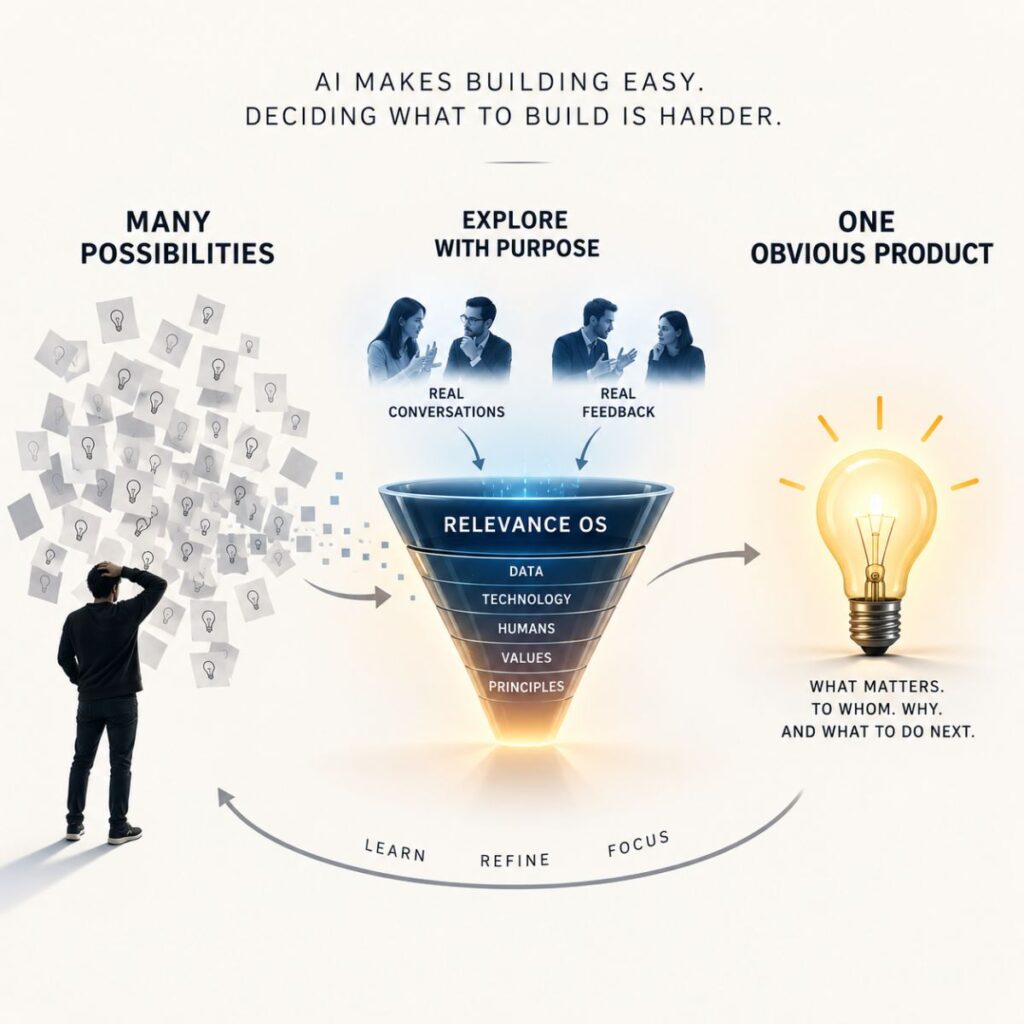
Steve Blank made the sharper version of this argument more than a decade ago, and Relefy’s earlier piece on his framework is worth bridging in directly here: as Blank explains in How to Build a Great Company, Step by Step, a startup is not a smaller version of a large company. It’s a temporary organization built to search for a repeatable business model, not execute a predetermined one. A traditional plan skips the search and treats an untested guess as if it were already a strategy. Blank’s alternative, the Business Model Canvas, replaces the plan’s narrative with nine explicit hypotheses, each one meant to be tested against reality, not defended in a room.
His instruction for testing them is blunt: get out of the building. There are no facts inside an office. Customer Development means talking to actual customers, not to pitch them, but to find out whether the assumed problem is even real. Build the smallest possible thing that lets the team learn, not the finished product imagined on a slide.
This is also where team size matters, but not in the direction “more planning, more structure” implies. Blank’s three phases, search, build, execute, mean a team of two to five in search phase needs founders doing the searching, not a hire trained to run a playbook that doesn’t exist yet. He flags bringing in a VP of Sales too early as one of the most common causes of startup failure, precisely because a great sales executive is built to execute a known model, and a search-phase team doesn’t have one. The lesson scales down cleanly: a five-person team writing a financial-projection-heavy plan over twelve months is doing execute-phase work during the search phase, regardless of whether it has investors reading it.
What teams actually did instead
Run that lens over recent founder profiles from Entrepreneur Media and the pattern holds at every team size in the sample, not just for individuals. Two teenage landscapers, a team of two, got handed a 50% deposit by a client who said he didn’t know why he trusted them. That deposit was the hypothesis test, not a forecast of one. Allison Chen and Amy Hsiao ran a café together and noticed their hosting and teaching sessions energized customers more than the café itself; they built Kitsby around that live signal, a pivot in Blank’s exact sense, changing the plan because the evidence demanded it, not firing anyone over it.
None of these teams ran a formal Customer Development process by name. None had a canvas on the wall. But each one tested a specific, falsifiable assumption against a real person’s money or a real person’s reaction in days or weeks, not months, before doing anything resembling planning. That’s search-phase behavior, executed by teams of one, two, and three, with no institutional audience requiring proof of it and no twelve-month clock attached to it.
The comfort the plan is actually selling
This is where the literature is most useful, almost by accident. Its strongest claims for business planning aren’t economic, they’re psychological: planning “reduces anxiety and stress,” gives founders “a vital companion in their journey,” and helps reduce isolation. Honestly stated, and worth noticing for what it actually is. As Relefy argued in The Activity Trap, the feeling of structured progress and the fact of progress are not the same thing. A document that exists to calm a small team down is solving the team’s nervous system, not the market’s demand. A business plan with no bank, no VC, and no grant office reading it is structure performed for whoever on the team is anxious enough to need it, on a clock borrowed from research that was never measuring them.
The misread to avoid
This isn’t an argument that thinking ahead is worthless, or that teams should build blind. Blank’s own framework is more rigorous than a business plan, not less, it just tests hypotheses sequentially against customers instead of compiling them into a forecast in advance. The argument is narrower: a body of research keeps measuring the comfort and legitimacy a document provides to institutional gatekeepers, on a timeline built for satisfying those gatekeepers, then gets cited as if it settles a question about whether founder-led teams without those gatekeepers need the same document on the same clock. They don’t have the same gatekeeper. They have a market that has never once asked to see a plan, and a search phase that ends the moment someone gets out of the building, often in less time than it takes to write the executive summary.
If the only entity requiring your business plan is your own team’s anxiety, what exactly is the document proving, and to whom?