
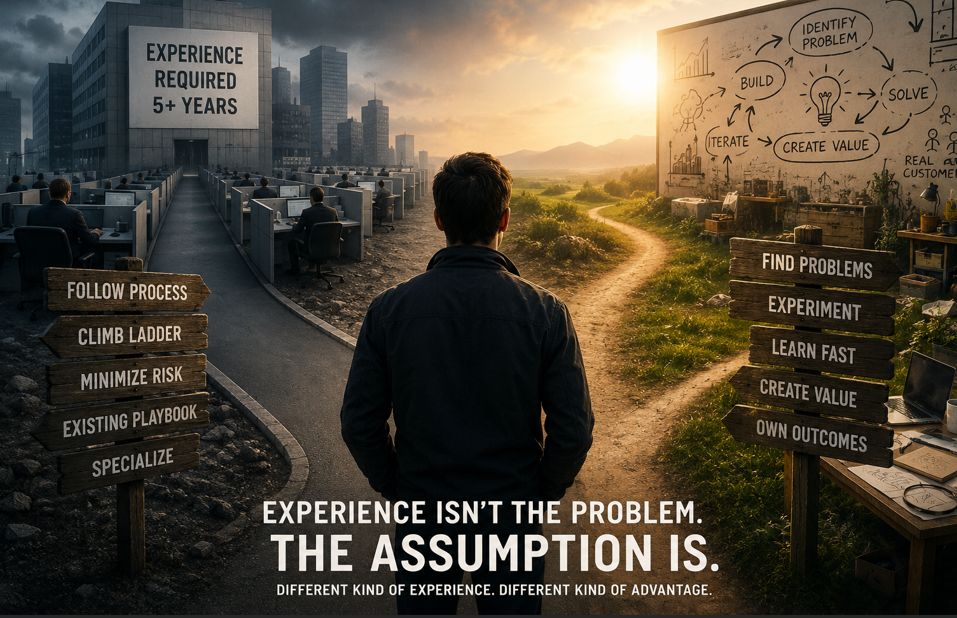
Apply for a mid-level role at almost any company and the first filter is years of experience. Five years minimum, the posting says, often before anyone reads a line about what you can actually do. The logic is simple: prior experience means proven playbooks, and proven playbooks reduce risk.
Now look at who actually built the companies that created new categories rather than competing inside old ones. Elon Musk had no aerospace background before SpaceX. Brian Chesky and Joe Gebbia were industrial designers, not hoteliers, before Airbnb. Daniel Ek came from web development and ad tech, not the record industry, before Spotify. Travis Kalanick built peer-to-peer file-sharing tools, not dispatch software, before Uber.
The job market and the founder track record are running on opposite assumptions about the same word. Both assumptions turn out to be correct. They are just measuring two different things and calling them by the same name.
The obvious objection, addressed before it undermines the rest
The data on entrepreneurial experience does not say inexperience wins. Founders who previously took a company public have roughly a 30% chance of succeeding again, according to the most cited empirical study on the subject, by Paul Gompers, Anna Kovner, Josh Lerner, and David Scharfstein in the Journal of Financial Economics. First-time founders in the same dataset succeed 21% of the time. Founders who previously failed succeed 22% of the time. Even a failed first attempt beats no attempt at all.
So experience matters enormously. What the data actually isolates is narrower and more useful than “experience helps.” It is: which kind of experience, applied to which kind of problem. A founder’s second attempt is not more successful because they finally know the industry. It is more successful because they have already lived through the specific, transferable process of building something from nothing, and that process turned out to be learnable. Domain knowledge, functional experience inside an established organization, and the meta-skill of running the 0-to-1 process are three different assets. Job postings, and most career ladders, are built to screen for the second one. The paradox is that category-defining companies keep getting built by people who had the third instead.
Curse of knowledge versus beginner’s mind
A domain expert knows exactly why an idea will fail. They have seen the version that didn’t work, they know which regulator will object, which customer segment won’t pay, which technical constraint kills it. This knowledge is real and it is usually correct, for the world as it currently exists.
It is also a documented liability, not just a folk observation. Economists Colin Camerer, George Loewenstein, and Martin Weber named this the curse of knowledge in a 1989 study: once someone knows something, they cannot fully reconstruct what it was like not to know it, and they systematically overestimate how obvious their own reasoning is to someone without their information. Applied to a market, the expert cannot accurately model the person who doesn’t know which rule is supposedly being broken, because the expert can no longer imagine not knowing it.
A related and separately documented effect compounds this. Chess research on what’s called the Einstellung effect tracked the eye movements of expert and novice players solving puzzles that contained a familiar-looking move alongside a better, less obvious one. Experts fixated on the familiar move and their attention kept returning to it, even after they consciously started searching for something else. The novices, who had no familiar move to latch onto, found the better solution faster. A known solution, once recognized, actively blocks the search for a better one.
Put these together and the beginner’s advantage stops being mystical. The novice does not have a superior mind. They have an absence: no failure pattern to fixate on, and no reason to unlearn before they can see what’s actually possible. When Musk investigated what it would cost to build a rocket from raw materials, he found the figure came to roughly 2% of what a finished rocket sold for, according to his own account in a 2012 Wired interview. Every aerospace incumbent had access to the same commodity prices. What they had that Musk didn’t was decades of institutional knowledge explaining why the other 98% was necessary.
The skill set is different, not absent
This is the point worth stating plainly: the outsider’s advantage is not the absence of experience. It’s a different kind of experience, developed somewhere else, that happens to transfer. Early-stage entrepreneurship runs on a specific set of capabilities: resourcefulness under constraint, rapid iteration, operating on incomplete information, identifying a real problem without being handed a brief, and creating value directly rather than through an established function inside someone else’s structure. These are learned skills with their own track record, not a blank slate.
This is also where the Gompers data actually clarifies the paradox instead of contradicting it. The 30% success figure belongs specifically to founders who already ran the 0-to-1 process once before. It is not domain expertise being rewarded. It is the meta-skill compounding. Kalanick’s transferable asset was building routing systems and consumer demand under legal pressure at Scour and Red Swoosh, not fleet logistics. Chesky and Gebbia’s transferable asset was designing for how people actually use a space, not running a hotel. None of it was industry knowledge. All of it was the underlying capability of building something from nothing under uncertainty, a capability a functional corporate role rarely requires and almost never trains.
Domain-specific experience inside an existing structure produces something different: real, hard-won expertise that tends to produce incremental improvement inside the existing frame rather than a new one. Hotel executives who saw the problem as “build more rooms” and record executives who spent a decade fighting piracy with lawsuits were both applying genuine expertise. It simply wasn’t the expertise the moment required.
None of this means a founder has to personally hold every kind of experience. The missing domain knowledge can be hired. A peer-reviewed study of founding teams at 153 Israeli technology startups, published in the Strategic Entrepreneurship Journal by Niron Hashai and Shaker Zahra, found that the effect of founders’ prior work experience on startup growth depends heavily on the mix: whether that experience came from the same industry, a different one, or both, and the payoff shifts as the venture matures. Experience, in other words, doesn’t have to live in one person. It can live across a team.
In principle, any company can build that mix: recruit the industry veteran, pair them with the person who has no fixed idea of how things are supposed to be done. In practice, established companies are worse at it than founding teams are. A founder can hand an outsider equity and real decision authority in a week. A corporate hiring process runs through leveling bands, internal political sponsorship, and a bias toward candidates who already resemble a known quantity, which filters out exactly the person whose value is that they don’t yet know the rules. The mechanism is available to everyone. The incentives inside most organizations quietly make sure only founders use it.
The pivot point: the same skills that build the company become the reason the founder leaves
Harvard Business School researcher Noam Wasserman spent a decade studying what happens after the 0-to-1 stage ends, and named the pattern the paradox of entrepreneurial success. Founder-CEOs are not usually removed because the company is struggling. In a sample of 212 startups from the late 1990s and early 2000s, half of all founders had already lost management control by the time their company turned three. By the time these companies went public, roughly 60% of founders were no longer CEO.
Strong performance was often the trigger, not weak performance. The skills that get a company from zero to product-market fit (ignoring consensus, deciding fast on incomplete information, keeping the structure flat) become liabilities once the organization needs governance, predictability, and delegation across layers the founder can no longer personally see into. The paradox flips completely at this point. The entrepreneur who benefited from having no playbook now needs one, and often needs someone else to bring it.
Steve Jobs is the case that shows the gap can actually be closed, and shows what closing it costs. When Apple’s board pushed him out in 1985, marketing veteran Regis McKenna’s assessment was blunt: Jobs had entered the business world with no management training and no business skills, and it showed. The twelve years that followed, building NeXT and running Pixar, are usually told as a wilderness story. Biographer Steven Levy has described it differently: Jobs learned to be collaborative, to cede control on a project he didn’t personally build, because at Pixar he wasn’t the one making the product. He also learned an entire industry, entertainment, from the ground up, alongside Pixar’s team. None of that was formal management training. It was a second apprenticeship, forced by circumstance, in exactly the skill set the first act had lacked. When Apple brought him back in 1997, he wasn’t the same founder they’d removed. He was, as one contemporary account put it, a decade older and two companies wiser. The pivot point isn’t always fatal. It’s just rarely survived by staying still, and rarely closed by reading about it instead of living through it.
Why the first rung matters, and why it’s shrinking
Everything above describes a choice founders have always faced. What’s changing is the alternative. For most people, the traditional way to acquire professional capability was the junior role: years spent inside an organization, making small decisions, learning from experienced colleagues, absorbing how real problems get solved, and gradually being trusted with bigger ones. That process did not necessarily teach 0-to-1 entrepreneurship. But it provided the apprenticeship through which inexperienced people became experienced professionals.. Relefy has previously argued that the entire education-to-employment pipeline was built to produce that kind of worker for an industrial economy that needed them. If that pipeline is weakening, the question this article is actually asking follows directly from it: where does someone acquire the capability that used to come from the first rung, if the first rung itself becomes harder to reach?
The evidence that the rung is narrowing is genuine, though the cause is contested. Stanford researchers Erik Brynjolfsson, Bharat Chandar, and Ruyu Chen, using high-frequency payroll data from ADP covering millions of workers across more than 730 occupations, found a 16% relative decline in employment for 22-to-25-year-olds in the most AI-exposed occupations since late 2022, a result that held even after excluding remote-friendly roles. Separately, Harvard economists have linked generative AI adoption to a sharp pullback in entry-level hiring at adopting firms, driven mainly by companies simply not replacing junior staff who leave rather than active layoffs.
Not every researcher agrees on the cause. A separate 2026 study by Peter John Lambert and Yannick Schindler argues remote work, not AI, is the stronger driver of the same pattern, since junior employees working remotely lose the informal mentorship that used to come from sitting near experienced colleagues. The Stanford finding holding after remote-friendly roles were excluded is a point against that explanation carrying the whole effect, but it doesn’t settle which factor dominates, and the honest reading is that both are probably operating at once. What the disagreement doesn’t change is the shape of the outcome: whatever the exact mix of causes, the traditional first rung is providing fewer people with the kind of experience it used to.
The skills being compressed fastest are the repeatable, codifiable ones a junior role used to teach through sheer repetition. The skills untouched so far are the ones entrepreneurship has always demanded: identifying a real problem, building distribution and sales, and creating value where no playbook exists yet. That doesn’t make entrepreneurial capability the only path left. It makes it one of the few paths whose value is not currently being eroded by the same forces narrowing the others.
What replaces a first rung that no longer exists
The honest answer is not that everyone needs to found a company. Most people won’t, and most of the value described here doesn’t require it. It requires taking on responsibility for an outcome before anyone has handed over a defined process for reaching it. That can happen inside a small business, a freelance practice, a side project, a piece of software built for a handful of real users, a community organized around a shared interest, an event that has to actually come together, or simply an internal initiative at an existing employer where no one has done exactly this before. What all of these share is not the label of “startup.” It’s the structure of the learning.
Traditional career development runs in one direction: education, then a junior role, then defined tasks executed inside someone else’s process, then specialization, then, eventually, responsibility. Entrepreneurial learning runs in the other direction: take on responsibility first, encounter the problems that responsibility creates, learn only what turns out to be necessary to solve them, and accumulate capability as a byproduct of having had no other choice. Neither order is inherently superior. But the second one doesn’t depend on an employer deciding to grant the first rung, which is precisely the part of the traditional path that’s becoming less reliable.
Which brings the argument back to the job posting this piece opened with. A five-year minimum is a proxy. It assumes years spent means capability gained, and it rarely asks what those years were actually spent doing. Five years repeating an established process inside a stable structure and five years figuring out how to create an outcome when no structure existed are both, technically, five years of experience. They are not the same five years. Companies that keep screening for the first without noticing they’re missing the second may find that the candidates who best fit the role they actually need never made it past the filter written for the role they used to hire for.
Entrepreneurship, in this light, is not the alternative to preparing for employment. It may be quietly becoming one of the more reliable ways to prepare for it.
Sources
Gompers, Kovner, Lerner, Scharfstein, “Performance Persistence in Entrepreneurship,” Journal of Financial Economics, 2010
Camerer, Loewenstein, Weber, “The Curse of Knowledge in Economic Settings: An Experimental Analysis,” Journal of Political Economy, 1989
Bilalić, McLeod, Gobet, “The Mechanisms and Boundary Conditions of the Einstellung Effect in Chess,” PLOS ONE
Musk’s first-principles account of SpaceX rocket costs, from Chris Anderson, “Elon Musk’s Mission to Mars,” Wired, October 2012 (cited here via secondary sources; original transcript should be checked directly, see note below)
Hashai and Zahra, “Founder Team Prior Work Experience: An Asset or a Liability for Startup Growth?” Strategic Entrepreneurship Journal, 2022
Wasserman, “The Founder’s Dilemma,” Harvard Business Review, 2008; “The Founding CEO’s Dilemma: Stay or Go?” Harvard Business School Working Knowledge
Regis McKenna on Jobs’s early management gaps, and Steven Levy on Jobs’s development at Pixar, as reported in TIME and CNN Business
Brynjolfsson, Chandar, and Chen, “Canaries in the Coal Mine? Six Facts about the Recent Employment Effects of Artificial Intelligence,” Stanford Digital Economy Lab, 2025
Hosseini and Lichtinger, Harvard working paper on entry-level hiring, covered by Forbes, 2026
Lambert and Schindler, “The Broken Ladder: AI, Remote Work, and Early-Career Hiring,” 2026
Relefy, “The World Was Built to Make You an Employee. That World Is Ending,” 2026