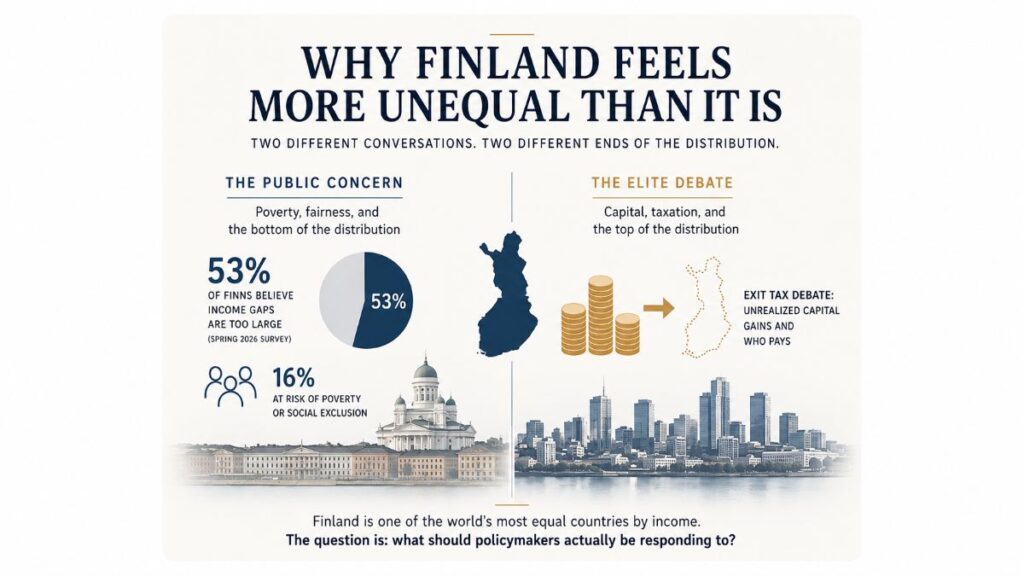
Finland has one of the lowest measured levels of income inequality in the world. Its Gini coefficient sits at 26.6, in the same range as Denmark, which has long been recognized as one of the most equal countries by this measure. Yet a spring 2026 survey by Eva, the Finnish business federation’s think tank, found that 53 percent of Finns believe income gaps have grown too large. That share has fallen from 75 percent in 2002, but it hasn’t come close to disappearing.
This isn’t a Finnish quirk. It’s a documented pattern in comparative political science, and Finland is one of its sharpest examples.
A comparative analysis of inequality perceptions across 40 countries, built on survey data from the International Social Survey Programme and inequality data from the Standardized World Income Inequality Database, sorts countries by the gap between their actual Gini and what their own citizens believe it to be. Anglo-Saxon, Latin American, and former socialist countries tend to underestimate their own inequality. The countries that overestimate it most, meaning the largest gap between actual and perceived inequality, include Slovakia, Croatia, Hungary, Ukraine, Sweden, Finland, and the Czech Republic. The United States and the United Kingdom, both with meaningfully higher actual Gini scores than Finland, sit in the group that underestimates its own inequality. Finland and Sweden, with some of the flattest income distributions in the world, sit in the group that overestimates theirs.
This doesn’t mean Finnish perception is simply wrong. Separate OECD research found that for each one-point rise in a country’s Gini index, the share of people who strongly agree that income gaps are too wide rises by close to two percentage points, meaning perception generally tracks the direction of actual change over time. Finland’s trend fits that pattern. Concern has declined by 22 percentage points since 2002, in a country where measured inequality has stayed low and stable across the same period. It’s the absolute level, more than half the population still calling one of the world’s more equal countries unequal, that breaks from the number on the page.
Part of the explanation is that “inequality” collapses two different concerns that people don’t actually feel the same way about. Research on fairness perception concludes that what bothers people generally isn’t economic inequality itself, it’s economic unfairness, and people consistently prefer a fair unequal distribution over an unfair equal one. Tolerance for concentration at the top rises further when the gains sit with a specific successful individual rather than a wealthy class, since people attribute an individual’s success to effort and skill in a way they don’t extend to a group. Aversion runs the opposite way at the bottom of the distribution, where reactions to visible deprivation are strongest, particularly among people who don’t already see the system as fair.
Eva’s own numbers fit this better than the headline figure suggests. Alongside the 53 percent who call income gaps too large, 65 percent of the same respondents accept pay differences based on skill and effort, and only 33 percent report real unfairness on hearing about wealthy individuals. These results suggest that concern may be directed less toward wealthy individuals than toward persistent poverty and social exclusion, which still affects roughly one in six Finns.
This distinction also underlies Finland’s unresolved debate over exit tax, even though the public rarely treats it as a separate question. The gap coming up in surveys is about income. The fight playing out among Finland’s economic elite is about something the Gini coefficient was never built to measure: concentrated, unrealized capital gains, and who has the right to tax them before they’re cashed out.
Antti Herlin, chairman of elevator manufacturer Kone’s board and Finland’s richest individual, argues that politicians, not departing wealth holders, are responsible for the outflow, pointing to an Aalto University study that found unlisted-company owners took 2.4 billion euros out of Finland between 2007 and 2022. Timo Ahopelto, founding partner at venture firm Lifeline Ventures, reversed his own position within months, first backing an exit tax if payment could be deferred until sale, then arguing Finland could never legislate one well. He holds tens of millions of euros in unrealized gains himself, a detail the reporting disclosed rather than left implicit. Anita Isomaa, tax director at the Confederation of Finnish Industries, says the country’s last attempt collapsed in 2022 because it tried to tax gains accrued even after someone had already left, rather than staying narrowly focused on residency-period value.
Norway offers the clearest contrast on exactly this point. Its 2022 law applies retroactively from the announcement date itself, specifically to stop wealthy residents front-running the policy, the way a wave of them had relocated to Switzerland ahead of a similar Danish move. Hector Ulloa, director of Norway’s tax research center Skatteforsk, argues that anyone who benefited from a country’s education, infrastructure, and legal protection while resident owes tax on the value built there, regardless of where they eventually sell. It’s a clean statement of the actual question at stake, and it has nothing to do with income distribution at all.
So Finland is running two separate conversations under one word. The public one concerns income distribution that is already among the most equal in the world, and the discomfort it produces looks more connected to poverty risk than to resentment of wealth. The elite one concerns a few thousand people’s unrealized capital gains, invisible to the metric the public conversation is implicitly reacting to, and not something the public itself claims to resent. They rhyme. They aren’t the same fight, and they aren’t even reacting to the same end of the distribution.
If a country’s sense of its own inequality can run this detached from the number meant to measure it, and if the detachment runs in different directions depending on whether the discomfort is about the floor or the ceiling, the more interesting question isn’t why Finns are wrong. It’s what policymakers should actually be responding to when they hear “the gap is too large”: the measured reality, the durable feeling about the bottom of the distribution, or the much smaller, much louder argument happening at the top.
Sources
Helsingin Sanomat, “Tutkimus: Yli puolet suomalaisista pitää tuloeroja liian suurina,” Sakri Pölönen, August 1, 2026 (Eva spring 2026 survey figures: 53 percent, 75 percent in 2002, 65 percent accepting skill/effort pay differences, 33 percent reporting unfairness toward the wealthy)
Wikipedia, “Economy of Finland” (Gini coefficient 26.6, 2023; AROPE at-risk-of-poverty-or-social-exclusion figure, 15.8 percent, 2023)
Wikipedia, “Income inequality in Denmark,” citing OECD and Eurostat data
Lee, Kim & Kim, “Comparative Analysis of Inequality Perception Gaps: Explaining the Gaps,” WAPOR working paper
OECD, “Does Inequality Matter? How People Perceive Economic Disparities,” 2021
Starmans, Sheskin & Bloom, “Why people prefer unequal societies,” Nature Human Behaviour, 2017
PNAS, “People are more tolerant of inequality when it is expressed in terms of individuals rather than groups at the top,” 2021
World Economic Forum, reporting on Goudarzi et al. research on fairness perception and reactions to visible poverty, 2020
Helsingin Sanomat, “Miten pääoman pako pysäytetään?” Juha-Pekka Raeste, August 2, 2026 (Antti Herlin, Timo Ahopelto, Anita Isomaa, Hector Ulloa)
Knüpfer, Samuli (Aalto University), study on capital outflow from Finland, 2007-2026, as cited in the above HS article