In June we argued that Finland’s debate about domestic pension investment was the right conversation in the wrong language. The case for pension funds backing Finnish growth companies kept losing because it was made as an obligation, not as an incentive.
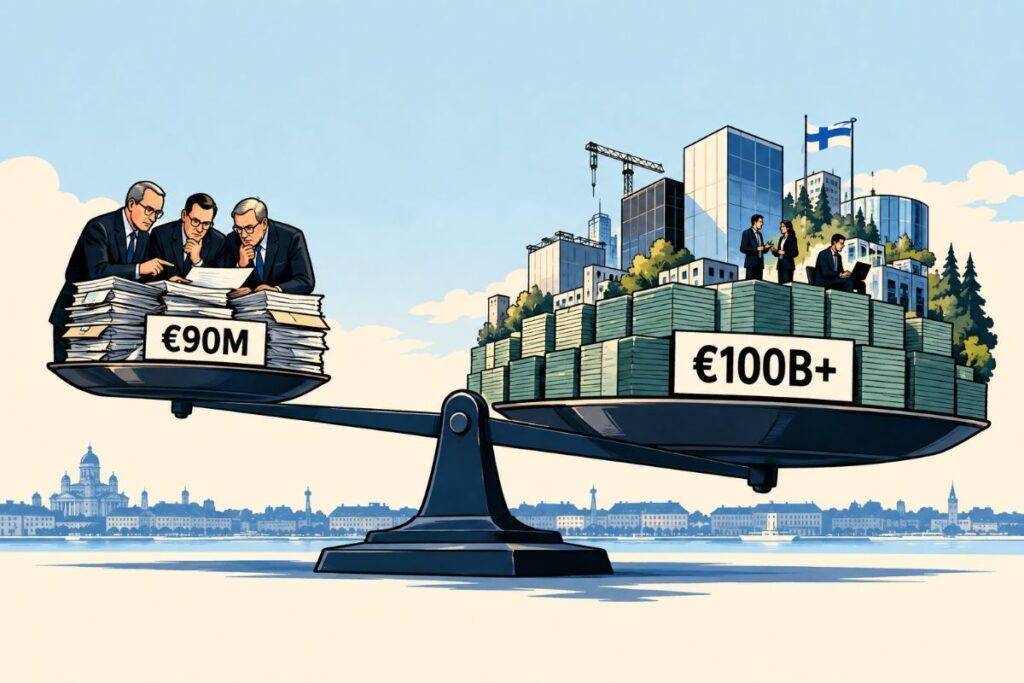
Three months later a new pension debate has opened. This one is about structure: how many pension companies Finland needs and what they cost to run. The people in it are fighting over tens of millions of euros. The system they are fighting over holds 300 billion.
This is not an argument for merging pension companies. It is not an argument against. It is an argument that the decision is being scored on the wrong number.
What is on the table
The debate started on 10 September. The Federation of Finnish Enterprises (Suomen Yrittäjät), the lobby for Finland’s small and medium-sized companies, published a study it had commissioned from Tarmo Valkonen, an economist who co-wrote a 2021 government report on the economics of population ageing. The study questions the case for Finland’s decentralised model, in which competing private companies run a statutory pension scheme. The Federation’s CEO, Mikael Pentikäinen, drew the conclusion: combine pension providers.
Speaking in a personal capacity, Pentikäinen told Kauppalehti, Finland’s main business daily, that Ilmarinen, Elo and Veritas should be merged. Those are three of the four private insurers that run earnings-related pensions for Finland’s private sector. The fourth is Varma.
The Federation’s adjustment programme for the next government attaches numbers. Efficiency gains across the earnings-related pension system: 150 million to 1 billion euros a year. Combining YEL, the entrepreneurs’ pension scheme, with MYEL, the farmers’ scheme: 100 to 150 million.
Carl Pettersson, CEO of Elo, answered in Kauppalehti on 14 September. Mergers are not on the agenda and no negotiations are underway, he said. Finland benefits from having several pension companies, both for competition and for its capital markets. He made a counter-proposal: bring price competition into YEL, so that an entrepreneur could get a cheaper policy from one company than from another. His evidence is TyEL, the employees’ scheme, where price competition was introduced three years ago. Since then TyEL implementation costs have fallen. YEL’s have not. Pentikäinen called it a good and bold proposal.
Then came the fight over the figures. Tela, the Finnish Pension Alliance, is the lobby for all of the country’s earnings-related pension providers. According to Tela’s Antti Tanskanen, running YEL and MYEL together costs a little over 90 million euros a year. Even if that fell to zero, the top of the Federation’s range would still be roughly 60 million short. Reaching it would mean raising contributions or cutting benefits. The Federation’s own paper points the same way. It describes the 100 to 150 million as a reduction in the state’s funding need, and part of it comes from phasing out a state subsidy on low-income farmers’ contributions.
The figure is disputed. So is the larger one. Minister of Social Security Karoliina Partanen noted that estimates of what mergers would save still vary widely.
This is a real debate with serious people on every side. It is also being conducted almost entirely on the smallest numbers in the system.
The cost line
Line the numbers up from the bottom.
YEL implementation costs a little over 60 million euros a year, according to Kauppalehti. Add MYEL and Tela’s figure is a little over 90 million. Administration across the whole earnings-related pension system, every scheme and every provider, cost 438 million euros in 2025.
Pettersson himself describes the realistic prize of YEL price competition as a few euros a month per entrepreneur and millions of euros a year at system level. Merger history gives the same order of magnitude. When Etera merged into Ilmarinen in 2018 and created Finland’s largest private pension insurer, the companies targeted at least 20 million euros a year in administrative savings and a further 20 million in investment costs.
That is worth doing. It is not what determines whether the system works. Tela’s CEO, Saara-Sofia Sirén, made the point herself in her reply to the Federation: administration is always worth making leaner, but no billion-euro solution is hiding in administrative costs.
The return line
Now the top of the ladder.
Finland’s earnings-related pension assets passed 300 billion euros at the end of June. The three companies in Pentikäinen’s merger scenario hold 112 billion of that: Ilmarinen 70.4 billion, Elo 36.3 billion and Veritas 5.5 billion.
A tenth of a percentage point of additional annual return on 112 billion euros is about 112 million euros a year. That is more than the entire annual cost of running YEL and MYEL combined. One percentage point is 1.1 billion.
Two misreadings to rule out. Nobody can order a tenth of a point. The arithmetic shows scale, not a plan. And these are not interchangeable pots. Investment returns flow into pension assets, not into the state budget. They do not plug the roughly 600 million euros a year the state pays to cover the YEL deficit.
But returns are where the long-term sustainability of earnings-related pensions is decided. Against that, administrative savings are rounding error.
On the table for one day
The return line did come up. Once.
The Federation’s release on 10 September said Finnish pension returns have trailed international peers, and that solvency rules limiting risk explain only part of the gap. Valkonen told Iltalehti, a national tabloid, that combining companies might save around 100 million euros a year, while solvency rules and investment returns involve considerably larger sums. Sirén answered the same day. What matters is net return against risk, she wrote, and on that measure Finnish pension insurers hold up well internationally. The comparison itself is disputed.
Then it disappeared. Four days later the argument was about YEL pricing and whether 150 million was 60 million too many. Pentikäinen’s follow-up on 18 September covers costs, contribution levels and customer churn. Investment returns do not appear in it.
The author of the study said the big number was somewhere else. The debate went to the small number anyway. Small numbers win debates because they can be checked in one sentence.
And one question never surfaced at all. Even on day one, returns were discussed as a benchmark, Finland against Norway’s oil fund, and as a rulebook, how much risk the solvency rules allow. The latest pension reform has already loosened that rulebook, and the companies can now carry more risk.
Nobody asked the structural question. Which of these organisations can build the capability to invest directly? And what would mergers, or competition, do to that capability?
What the merger question is really about
Our June piece rested on the Canadian model. Canada’s largest public pension funds invest directly, through internal teams hired at market rates, governed by boards of experienced professionals and protected from political capture by a strict fiduciary framework.
That model depends on scale. A direct-investment team with real sector expertise and deal-sourcing capability is expensive to build. It only pays off across a large enough asset base.
Seen through that lens, the merger question is not about back-office savings. It is about which structure can credibly run a ring-fenced unit for direct growth investment: hire from venture capital and growth equity, set return targets that match the risk, co-invest alongside private capital, and hold or exit positions on commercial logic alone. A 70 billion euro house can plausibly build that. A 5.5 billion euro house almost certainly cannot on its own. A 36 billion euro house sits in between.
That does not make mergers the answer. Pettersson’s concern about concentration is legitimate. Collapse the largest private pension investors into one and a small market gets a single dominant allocator, fewer competing views on risk and less pressure on costs. Sirén puts the extreme case as a question: what would keep a single 300 billion euro pension institution efficient without competition, and what would contain its investment and political risks?
But the choice is not only merge or don’t merge. Capability can be pooled without pooling ownership.
Finland already does this, two steps removed. Tesi, the state-owned investment company, manages a series of funds of funds called Kasvurahastojen Rahasto, or KRR. The fifth, launched in 2024 at 200 million euros, counts Elo, Ilmarinen and Veritas among its investors, alongside the public-sector pension investors Keva and VER. The three companies in the merger scenario are already pooling money for Finnish growth. They pool it into a fund that invests in funds that invest in companies.
The missing version is the same pooling pointed at direct investment. A jointly backed vehicle with its own professional team, a commercial mandate and clear co-investment rules. The companies behind it stay separate and keep competing everywhere else. Plurality in governance and pricing. Scale in direct-investment capability.
That option is not in the debate. The debate left investment after one day.
Pettersson already believes in incentives
The most interesting thing about Pettersson’s YEL proposal is its logic. He is not arguing that pension companies should be efficient because it is their duty. He is arguing that visible prices and real competition will force them to be. When customers can see what they pay and how efficiently each company operates, efficiency follows.
Pentikäinen agrees. The man who wants mergers and the man who rejects them hold the same view of the mechanism: make performance visible and let the companies compete on it.
That is also the logic of the case for domestic investment. Incentives beat mandates. Pettersson has applied it to a cost line of around 60 million euros. It applies with far more force to the 36 billion euros Elo invests. Make direct domestic investment as visible as administrative efficiency, and let the pension companies compete on it.
A claim worth testing
Pettersson also said that several pension companies matter for Finnish capital markets. That is the one claim in the current debate that ties structure to investment. It deserves to be tested, not waved through.
There are numbers to start from. Sirén’s reply for Tela states that 54 billion euros of pension assets are invested in Finland, and that pension insurers’ investments in Finnish growth companies came to about 3.2 billion euros in 2025 and are rising. Against 300 billion, that is about one percent. Tela does not say how much of it is direct.
Pettersson has published Elo’s own figure. In a blog post in March he wrote that Elo invested more than 100 million euros in Finnish growth companies in 2025 and about 400 million over five years, a large part of it through Finnish private equity and venture funds. Set against a 36.3 billion euro portfolio, 100 million is under 0.3 percent.
He also set a limit in that post, and it belongs in this argument. Capitalising Tesi or leaning on pension companies will not build the next Finnish success stories, he wrote. Private, return-seeking capital has to be in the driver’s seat. That is an argument for co-investing behind private lead investors. It is not an argument against investing directly.
Elo’s best-known example fits his description. It has backed Lifeline Ventures, the Helsinki venture firm that was an early backer of Supercell, Wolt and Oura, four consecutive times since 2016. That is a sound investment decision. It is also indirect.
As we argued in June, investing through funds captures part of the financial return and none of the structural advantage unique to a Finnish pension investor: the loop through which Finnish growth creates Finnish payroll, which grows Finnish pension contributions, which grows the investor’s own capital base. That loop belongs only to the direct investor.
So the test is simple. If several pension companies are good for Finnish capital markets, show what each one invests directly in Finnish growth companies, next to what it routes through funds.
Interested parties, all of them
Everyone in this debate has a position to defend.
Elo is Finland’s largest insurer of entrepreneurs, with about 84,000 YEL policies at the end of 2025, and its CEO is proposing a change to how YEL is priced. Pettersson also chairs the board of Tela, the association rebutting the Federation’s numbers.
Pentikäinen proposes merging Elo while sitting on its supervisory board. Elo’s annual meeting re-elected him in April for a term running to 2029.
Tela represents the providers whose structure is in question, and maintaining decentralised implementation is written into its strategy. The study that opened the debate was commissioned by the organisation proposing the mergers.
None of that disqualifies anyone. It is a reason to judge each proposal by the number it optimises, not by who makes it.
The deeper point
The timing matters. A parliamentary working group on fiscal policy has set the frame for the government that takes office after the spring 2027 election: a consolidation package of 8 to 11 billion euros, according to the Ministry of Finance. Pensions are already in that frame. The first savings line in the Federation’s adjustment programme is pension-system efficiency. The proposals being positioned now will shape that negotiation.
The government has also launched a study on pre-funding entrepreneurs’ pensions. If that leads to a funded YEL, it creates a new pool of capital, and the question of how to invest it starts from a blank page.
Before Finland decides how many pension companies it needs, it should decide what they are for. If the answer is administration, count the administrative costs and merge accordingly. If the answer is long-term returns for beneficiaries, including the returns that compound through Finnish employment, then the question is which structure can build real investment capability, and whether it can be done without giving up competition.
Finland is counting the administration. Nobody is counting the capability.
Tela can already count 3.2 billion euros of pension money in Finnish growth companies. How much of it is direct, and which pension company will be the first to publish its own figure?
Sources
-
Kauppalehti, Olli Kuivaniemi, “Eläkepomolta uusi avaus: Yrittäjien eläkemaksuihin iso periaatteellinen muutos”, 14.9.2026. Interviews with Carl Pettersson (Elo), Antti Tanskanen (Tela) and Minister Karoliina Partanen. Paywalled.
-
Suomen Yrittäjät, press release on the Valkonen study, 10.9.2026
-
Suomen Yrittäjät, Julkisen talouden sopeutusohjelma, September 2026
-
Suomen Yrittäjät, news item on Pettersson’s Kauppalehti interview, 14.9.2026
-
Mikael Pentikäinen, “Eläkejärjestelmää voi tehostaa tuntuvasti”, Suomen Yrittäjät blog, 18.9.2026
-
Suomen Yrittäjät, news item on the YEL reform and the pre-funding study, 2.9.2026
-
Tela, Saara-Sofia Sirén, “Suomen Yrittäjiltä unohtui mittasuhteet ja yrittäjien odottama YEL-uudistus”, 10.9.2026
-
Tela, pension assets pass 300 billion euros, 28.8.2026
-
Tela, strategy
-
Tela, commentary by board chair Carl Pettersson, 16.3.2026
-
Iltalehti, Jari Hanska, “Eläkeyhtiöiden kulut jopa miljardeja”, 10.9.2026
-
Ilmarinen, half-year report January to June 2026, 18.8.2026
-
Veritas, interim report January to June 2026, 27.8.2026
-
Ilmarinen, Financial Supervisory Authority approves the Etera merger, 2017
-
Elo, Carl Pettersson, “Kasvuun tarvitaan rohkeaa pääomaa, ei vain julkista rahaa”, 31.3.2026
-
Elo, investor in Lifeline Ventures’ 400 million euro fund, 21.10.2025
-
Elo, 2025 results, 13.2.2026
-
Elo, annual general meeting decisions, 20.4.2026
-
Tesi, Kasvurahastojen Rahasto V launch, 8.2.2024
-
Ministry of Finance, “Seuraavan vaalikauden sopeutustavoite on vaativa mutta täysin mahdollinen saavuttaa”, 27.2.2026
Related Relefy coverage
-
“The Right Case for the Wrong Reason” Relefy, 16.6.2026